More Than a Month: Four AAPI Books Worth Reading Any Time

grayscale photo of woman holding fan
Photo by David Herlianto on Pexels.com

May is Asian American and Pacific Islander Heritage Month, and I want to say upfront what the original version of this post said: the AAPI label is genuinely strange. It groups together cultures, languages, histories, and identities spanning East Asia, South Asia, and the Pacific Islands — and, in some definitions, parts of the Middle East. That’s not a coherent category. It’s an administrative convenience that sometimes tips into erasure.

But as Harmeet Kaur observed at CNN, it persists because there’s no better single term, and the absence of a better term isn’t a reason to ignore the writers. So I use the label the way it’s intended — as an imperfect placeholder that points to a vast and varied literary tradition that deserves attention well past the calendar month it’s been assigned to.

The four books below are what I was reading and recommending this past year. They have almost nothing in common except that the authors are Asian American or Pacific Islander and all four books are, in different ways, extraordinary.


Audition — Katie Kitamura

Literary Fiction · Riverhead Books, 2025
Get it on Amazon

An accomplished actress meets a young man for lunch in a Manhattan restaurant. He claims to be her son. She knows this is impossible — she has never given birth. And yet…

That setup sells Audition short. What Kitamura is actually doing is something considerably more disorienting: building a novel that questions whether identity itself is stable, whether the roles we play — partner, parent, artist, stranger — are performances we choose or fictions we’re trapped inside. The book is structured to generate maximum uncertainty about what’s real and who the narrator actually is.

The prose is the reason the book has the reputation it has. Kitamura writes with an austerity that makes every sentence carry weight beyond its apparent content. The Observer called it like “reading a knife out of the freezer.” Audition was shortlisted for the 2025 Booker Prize, named a Barack Obama favorite book of the year, and landed on nearly every major best-of list. If you’ve been putting it off because the premise sounds slight, trust that Kitamura is doing much more than the premise suggests.

For educators specifically: there’s a conversation to be had about this book and the performance demands of teaching — the way we occupy professional roles that are partly constructed, partly real, and always subject to revision by the people watching us. The Science of Learning and Development tells us that relationships are the substrate of learning; Audition asks what a relationship even is when you can’t be certain who the other person is.


Hammajang Luck — Makana Yamamoto

Science Fiction / Heist · Harper Voyager, 2024
Get it on Amazon

Hammajang is Hawaiian Pidgin for “all messed up” — and that’s both the state of Edie’s life when the novel opens and a fairly accurate description of the plan they’re about to agree to. Edie just got out of prison after eight years. Their sister is pregnant and their niece is sick. They need money and can’t get hired anywhere because they once tried to rob a trillionaire tech god. And now that tech god’s ex-partner is back, with one more job, and Edie is — inevitably — going to say yes.

Hammajang Luck is a queer, AAPI cyberpunk heist novel set on a space station, and Yamamoto was born on Maui and uses Hawaiian Pidgin as a living language of the future rather than an archaeological curiosity. That choice alone is worth your attention — the genre history of science fiction is full of futures where cultural diversity has been flattened into homogeneity, and Yamamoto’s novel pushes back against that directly.

It’s also just enormously fun. The Ocean’s Eight comparisons are everywhere in the reviews and they’re accurate: a lovable crew with complementary skills, a target who deserves what’s coming, and an enemies-to-lovers subplot threading through the heist logistics. Publisher’s Weekly called it “a blast.” Read it when you need something that fully delivers on its premise.


Searches: Selfhood in the Digital Age — Vauhini Vara

Nonfiction / Essay Collection · Grove Atlantic, 2025
Get it on Amazon

If you’ve been thinking about AI and identity — and at this point, who hasn’t — Vara’s essay collection is the most honest and most personal thing I’ve encountered on that terrain. You may know her from the viral 2021 essay in which she used GPT to write about her sister’s death, collaborating with a language model on her grief because she couldn’t write it alone. Searches extends that project outward: into how the internet reshapes how we construct and present ourselves, what we lose and what we gain in digital mediation, and what it means to be a person in a world that increasingly reflects your searches back at you.

Vara writes from the inside of these questions — as a journalist who has covered the tech industry, as someone who has used AI for genuinely personal work, as a person whose identity has been filtered through systems she didn’t design. This is neither utopian enthusiasm nor panic. It’s harder than both.

The Connectivist in me finds Vara’s work fascinating for the way she grapples with knowledge distributed across networks — the way digital tools aren’t just things we use but environments that shape us, systems that alter the connections through which we come to know ourselves. Siemens would recognize the landscape she’s describing. So would any student who has tried to figure out who they are in the era of algorithmic recommendation.


The Manor of Dreams — Christina Li

Gothic Fiction / Family Drama · Atria Books, 2025
Get it on Amazon

Chinese American actress Vivian Yin dies and leaves a will that surprises everyone — including her daughters, who expected to inherit her estate and instead find themselves entangled in a mystery centered on a possibly haunted manor and family secrets thick enough to be load-bearing.

Li has a gift for atmosphere and generational tension, and The Manor of Dreams earns its gothic credentials honestly: the house has genuine menace, the family has genuine wounds, and the mystery slowly reveals itself in ways that feel earned rather than mechanical. This is the book for readers who want something immersive and emotionally layered and willing to sit in unease.

It also does something that the best family stories do — it treats the silences and evasions between generations as a form of communication in themselves, as meaningful as anything said directly. The things Vivian’s daughters don’t know about their mother aren’t gaps to be filled; they’re the story.


Why This List Exists

The point of “AAPI Heritage Month” — like Black History Month, like Hispanic Heritage Month — was never to contain the literature and the histories to a single calendar slot. The books above were published across 2024 and 2025, written by authors from Maui, from Chinese American families, from Japanese American journalism, from communities that have been making literature in and about the United States for generations. They don’t fit into a single tradition or aesthetic. They don’t represent “the AAPI experience” — there is no such single experience.

What they represent is what all good literature represents: people thinking carefully about the world they inhabit, in forms specific enough to be true and resonant enough to travel. Read them because they’re excellent. The month is incidental.


Related on this site: Why aren’t people reading books anymore? explores the structural forces that narrow what gets read — which connects directly to why reading outside the default matters.


The Eclectic Educator is a free resource for everyone passionate about education and creativity. If you enjoy the content and want to support the newsletter, consider becoming a paid subscriber. Your support helps keep the insights and inspiration coming!
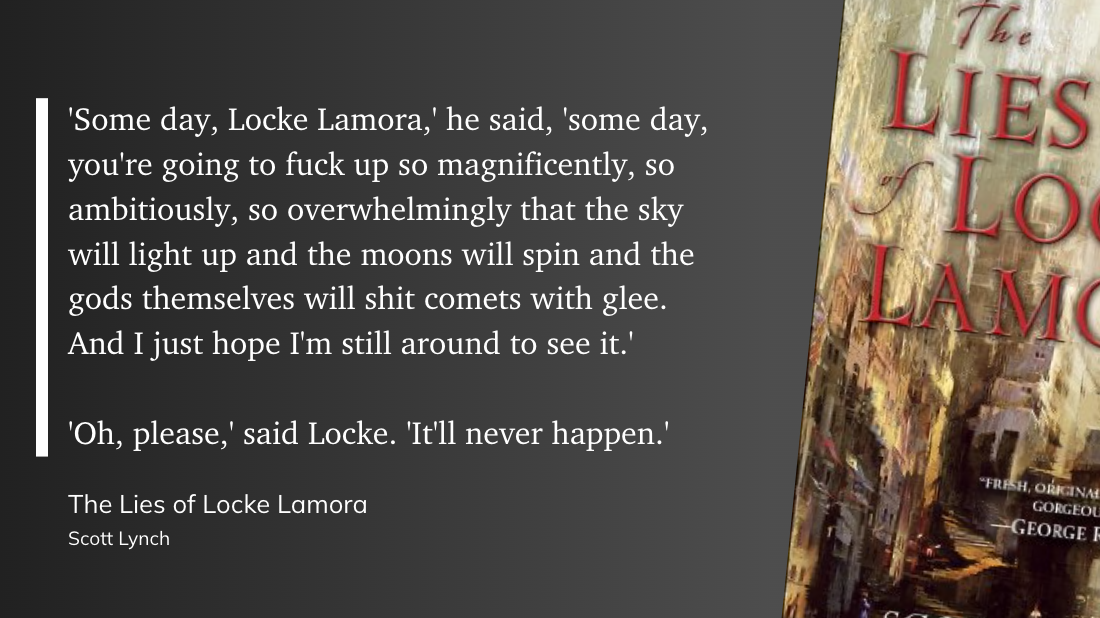
Book Review – The Lies of Locke Lamora

There is a moment early in The Lies of Locke Lamora where Father Chains — the blind priest who is not actually blind, and not actually a priest — explains to a young Locke Lamora exactly what kind of criminal he’s going to become. Not a common thief. Not a hired blade. Something more specific and considerably more dangerous: a con artist who targets the nobility of Camorr, the one category of victim that the city’s organized crime syndicate has quietly agreed to leave alone.

The Gentleman Bastards Secret. That’s what Lynch calls it. And the audacity of it — stealing from the most powerful people in a city run by criminals, hiding that fact from the criminals themselves — tells you everything you need to know about whether this book is for you. If that premise makes you grin, buckle in. If it makes you anxious about what happens when it inevitably unravels, also buckle in.


What It Is

The Lies of Locke Lamora is Scott Lynch’s 2006 debut novel, the first in the Gentleman Bastards series. It is set in Camorr, a fictional city that is essentially Renaissance Venice run by the mob — canals, ancient towers of alien glass left by a vanished civilization, a rigid criminal hierarchy, and enough filth and beauty coexisting in the same frame to make you feel like you’re actually there.

Locke Lamora is an orphan who becomes the most gifted con artist in Camorr. His crew, the Gentleman Bastards, pulls elaborate long cons against the city’s wealthy nobility — a category of victim so off-limits in the criminal underworld that nobody would think to look for thieves there. The book follows two timelines: the present day, where Locke is running his most ambitious scheme yet, and a series of interludes tracing his childhood and how he became who he is.

The comparison that keeps appearing in reviews is Ocean’s Eleven meets The Godfather. That’s accurate as far as it goes. I’d add: with the warmth of a found-family story underneath all the deception, and the gut-punch of grimdark fantasy when the plot decides to stop playing nice.


Why It Works

The thing everyone who loves this book mentions first is the voice. Lynch writes dialogue the way someone who genuinely enjoys language writes dialogue — it’s witty and foul-mouthed and character-specific in a way that feels earned rather than performed. The Gentleman Bastards bicker and insult each other constantly, and you understand their loyalty to each other precisely through the texture of how they argue. Nobody’s monologuing their feelings. Nobody needs to.

The dual-timeline structure is handled well. The interludes into Locke’s childhood do what flashbacks are supposed to do — they recontextualize what you’re reading in the present without dragging the plot sideways. By the time certain things happen in the present-day story, you’ve been prepared to feel them much more deeply than you would have if Lynch had told the story straight through.

Jean Tannen deserves particular mention. He is Locke’s best friend and the beating heart of the crew — a big, quiet, book-loving man who happens to be extraordinarily violent when the situation calls for it. The relationship between Locke and Jean is what gives the novel its emotional stakes. You root for the heists because they’re clever. You root for these characters because you genuinely care whether they survive.

The world-building is immersive without being oppressive. Lynch doesn’t stop the story to explain his world to you — he trusts the details to accumulate naturally, and they do. Camorr feels lived-in. The Elderglass towers feel genuinely strange. The criminal hierarchy feels as if it has a history that extends well before chapter one.


The Honest Part

The beginning is slow. This isn’t a controversial opinion — almost every review of this book, including the glowing ones, mentions it. The first fifty or so pages are dense with world-building and character setup, and the plot hasn’t found its footing yet. Lynch is laying track, not racing on it. If you trust the process, it pays off enormously. If you need momentum from page one, you might not get there.

The violence, when it comes, is not cartoonish. This is grimdark fantasy. People die suddenly and badly. Some of the deaths are genuinely brutal in a way that’s meant to be felt, not just processed as plot information. This is not a book that treats its violence as consequence-free, which I consider a feature. But it’s worth knowing going in.

There’s also the series situation, which I’d be dishonest not to mention: Lynch published The Lies of Locke Lamora in 2006, Red Seas Under Red Skies in 2007, and The Republic of Thieves in 2013. Book four has been in progress for over a decade with no confirmed publication date. If starting an unfinished series is a dealbreaker for you, that’s worth knowing. If, like me, you’ve long since made peace with the reality that some authors write slowly and the books that do exist are worth having, the first three are genuinely excellent.


The Verdict

This is one of the best fantasy debuts I’ve read. Lynch wrote a book that is simultaneously a heist thriller, a crime novel, a coming-of-age story, and a meditation on what friendship and loyalty actually mean when you’ve chosen a life built on deception. The pieces shouldn’t fit together as well as they do. They fit together perfectly.

The quote image I’ve kept from the original review captures the book’s energy better than most descriptions:

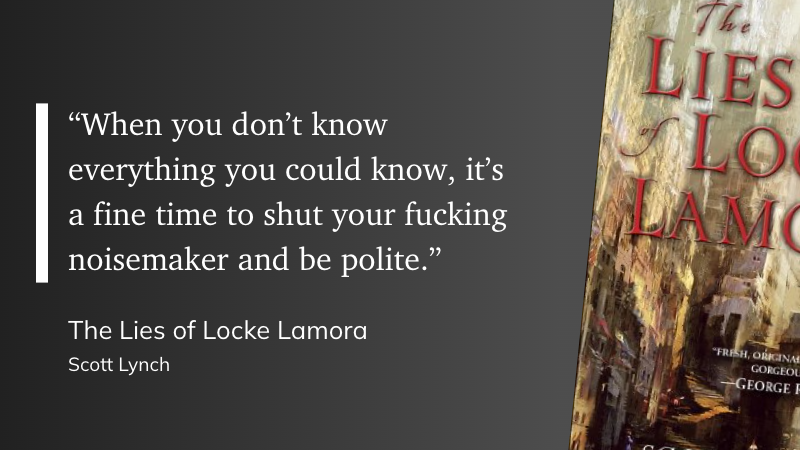
“When you don’t know everything you could know, it’s a fine time to shut your fucking noisemaker and be polite.” (Scott Lynch, The Lies of Locke Lamora)

“When you don’t know everything you could know, it’s a fine time to shut your fucking noisemaker and be polite.”

— Scott Lynch, The Lies of Locke Lamora

That’s the book. Clever, profane, self-aware, and ultimately warmer than it has any right to be.

Rating: 4.5 out of 5 stars. (I bumped it up from my original 4 on reflection. The slow opening earned the half-star deduction; everything that follows earned it back.)

Get The Lies of Locke Lamora


If You Liked This, Read Next

Red Seas Under Red Skies — The immediate sequel. Locke and Jean, new city, new con, new catastrophe. Different in tone (nautical heist rather than urban), equally entertaining.

The Republic of Thieves — Book three, and the one that finally explains the backstory of someone the first book only hints at. The most emotionally complex of the three published novels.

Six of Crows by Leigh Bardugo — The most common recommendation for readers who loved Locke Lamora. Morally grey crew, elaborate heist, excellent found-family dynamics. Younger in tone — less grimdark — but equally compelling.

The Name of the Wind by Patrick Rothfuss — Lynch and Rothfuss debuted within a year of each other and were constantly compared in the mid-2000s fantasy scene. Rothfuss is lyrical where Lynch is propulsive, but both center on a protagonist who is the most gifted person in the room and knows it. Also an unfinished series, alas.

The Blade Itself by Joe Abercrombie — If the grimdark edge of Locke Lamora is what hooked you — the sense that consequences are real and survival is not guaranteed — Abercrombie is the natural next stop. Darker, bleaker, absolutely brilliant.


Filed under: the pile of books recommended to me by multiple people who know my taste, and whose recommendations were entirely correct.


The Eclectic Educator is a free resource for everyone passionate about education and creativity. If you enjoy the content and want to support the newsletter, consider becoming a paid subscriber. Your support helps keep the insights and inspiration coming!

The Best Books for Understanding AI — A Reading List for Educators and Curious Humans

elderly man thinking while looking at a chessboard
Photo by Pavel Danilyuk on Pexels.com

A quick note before the list: I’ve been living in this space for a while now — as an instructional coach, a Google Certified Innovator, a doctoral student, and someone who uses AI tools daily in my actual work. The books I’m recommending here are ones I’d press into the hands of a thoughtful educator or a curious non-technical reader. This is not a developer’s reading list. If you want to build LLMs from scratch, you’re reading the wrong blog.

What I care about: understanding what these systems actually are, what they can and can’t do, what they mean for teaching and learning, and how to think clearly about the cultural and ethical questions they raise. The AI book market has exploded with hype, doom, and everything in between. Most of it isn’t worth your time. Here’s what is.


Where to Start

Co-Intelligence: Living and Working with AI — Ethan Mollick (2024)

This is the book I recommend first to every educator asking me where to begin, and it’s not particularly close. Mollick is a Wharton professor who has been using AI in his classroom since the day ChatGPT launched and writing about it — honestly and with genuine curiosity — at his Substack ever since. Unlike most AI books, this one was written by someone with actual daily practice rather than theoretical distance.

The central argument is in the title: AI as co-intelligence, not replacement intelligence. Mollick’s four rules for working with AI are practical enough to start using today and deep enough to keep thinking about. His concept of the “jagged frontier” — that AI is weirdly capable at things we’d consider hard and oddly bad at things we’d consider easy — is the single most useful mental model I’ve found for calibrating what to expect.

For educators specifically, Chapter 7 on AI in schools is worth the price of the book alone. Mollick is genuinely thoughtful about the implications for assessment, expertise development, and what we’re actually asking students to do when we assign traditional work in an era of capable AI tools. He doesn’t hand you easy answers. He asks better questions.

Worth noting: some readers already deep in this space find it a bit surface-level, and it was written in 2023, so some specifics are already dated. Read it for the framework, not the technical details.

Get Co-Intelligence


Understanding What AI Actually Is

Artificial Intelligence: A Guide for Thinking Humans — Melanie Mitchell (2019)

Still the best accessible introduction to what AI fundamentally is and isn’t. Mitchell is a computational complexity researcher at the Santa Fe Institute, and she brings real intellectual rigor to a topic that attracts an unusual amount of noise. This book predates the LLM explosion, which is actually part of what makes it valuable — it gives you the conceptual foundation to understand why systems like GPT surprised even the researchers who built them.

Mitchell is especially good on the gap between narrow AI capability and what we loosely call “understanding.” If you want to have an informed opinion about whether AI is “really” thinking, read this first.

Get Artificial Intelligence: A Guide for Thinking Humans


The Coming Wave: Technology, Power, and the Twenty-First Century’s Greatest Dilemma — Mustafa Suleyman (2023)

This is the big-picture book. Suleyman co-founded DeepMind and Inflection AI before becoming CEO of Microsoft AI — he is, in other words, someone who has spent his career at the center of this thing. The Coming Wave is his argument that we are facing a genuine civilizational inflection point with AI (and synthetic biology), and that the window to build appropriate containment structures around these technologies is narrowing rapidly.

What distinguishes it from most AI doom-or-boom books is specificity. Suleyman doesn’t deal in vague anxieties — he makes concrete arguments about the concentration of power, economic disruption, and the structural problems of trying to regulate technology that spreads faster than governance can follow. Readable, serious, and useful for understanding why AI isn’t just a productivity story.

Get The Coming Wave


The Ethics and Alignment Problem

The Alignment Problem: Machine Learning and Human Values — Brian Christian (2020)

If you want to understand why making AI systems that reliably do what we want them to do is genuinely hard — technically, philosophically, and ethically — this is the book. Christian spent years interviewing researchers at the leading AI labs and built a rigorous, human-readable account of the problem at the center of AI safety.

The alignment problem isn’t abstract. It shows up in recommendation systems that optimize for engagement and produce radicalization. It shows up in hiring algorithms that encode historical discrimination. It shows up every time a system is optimized for a measurable proxy of what we actually want, rather than the thing itself. Christian is excellent on how this happens, why it’s hard to fix, and what the researchers working on it are actually doing.

This book complements Mollick’s more optimistic framing well. Read both.

Get The Alignment Problem


Atlas of AI: Power, Politics, and the Planetary Costs of Artificial Intelligence — Kate Crawford (2021)

The critical perspective this list needs. Crawford, a researcher at USC and co-founder of the AI Now Institute, makes a compelling argument that AI systems are not software abstractions — they are material, political, and economic objects with real costs and embedded power dynamics. The rare earths in the hardware, the data center energy consumption, the contract workers’ labeling training data in difficult conditions, and the labor displacement — Crawford maps all of it.

I don’t agree with everything in this book, and Crawford’s perspective is explicitly critical rather than balanced. But the questions she raises are important and underrepresented in the mainstream AI conversation. If you’ve read Mollick and want a counterweight, this is it.

Get Atlas of AI


The History and the People

Genius Makers: The Mavericks Who Brought AI to Google, Facebook, and the World — Cade Metz (2021)

The best narrative history of the deep learning revolution. Metz is a New York Times technology reporter who covers this beat obsessively, and he had remarkable access to the key figures: Geoffrey Hinton, Yann LeCun, Demis Hassabis, and the others who turned decades of dormant theory into the technology now reshaping every industry.

This is the book if you want to understand why everything changed so fast after 2012, what the competitive dynamics between labs looked like, and how the researchers themselves thought about what they were building. Reads like a thriller — the science is real, the rivalries are real, and the ethical stakes land harder when you know the people involved.

Get Genius Makers


For Educators Specifically

Brave New Words: How AI Will Revolutionize Education (and Why That’s a Good Thing) — Salman Khan (2024)

Sal Khan founded Khan Academy. He’s also an optimist, which comes through clearly in this book. Brave New Words makes the case for AI as tutor, mentor, and educational equalizer — arguing that tools like Khanmigo can bring the one-on-one tutoring advantage (Bloom’s famous “two sigma” finding, that individual tutoring improves outcomes dramatically over classroom instruction) to every student who needs it.

I read this more critically than I read Mollick, because the institutional interests are more directly aligned with the argument. But the core vision — that AI could close genuine equity gaps in access to high-quality educational support — is worth taking seriously, and the specific examples from Khan Academy’s work are compelling. Read it alongside the Crawford book for balance.

Get Brave New Words


The Short Version

If you read only one: Mollick’s Co-Intelligence. It’s the most practical and most directly relevant to anyone working in education or doing knowledge work of any kind.

If you want the big picture: Suleyman’s The Coming Wave. The most serious argument about what’s actually at stake.

If you want the history: Metz’s Genius Makers. The best story of how we got here.

If you want the ethics: Christian’s The Alignment Problem for the technical/philosophical dimension, Crawford’s Atlas of AI for the political/material dimension.


These books sit alongside my broader reading on technology and education — if you’re interested in that context, the Zettelkasten post covers the note-taking system I use to actually hold onto what I read across all of this.


The Eclectic Educator is a free resource for everyone passionate about education and creativity. If you enjoy the content and want to support the newsletter, consider becoming a paid subscriber. Your support helps keep the insights and inspiration coming!
2,178 Digitized Occult Books: Strange Treasures for Authentic Learning

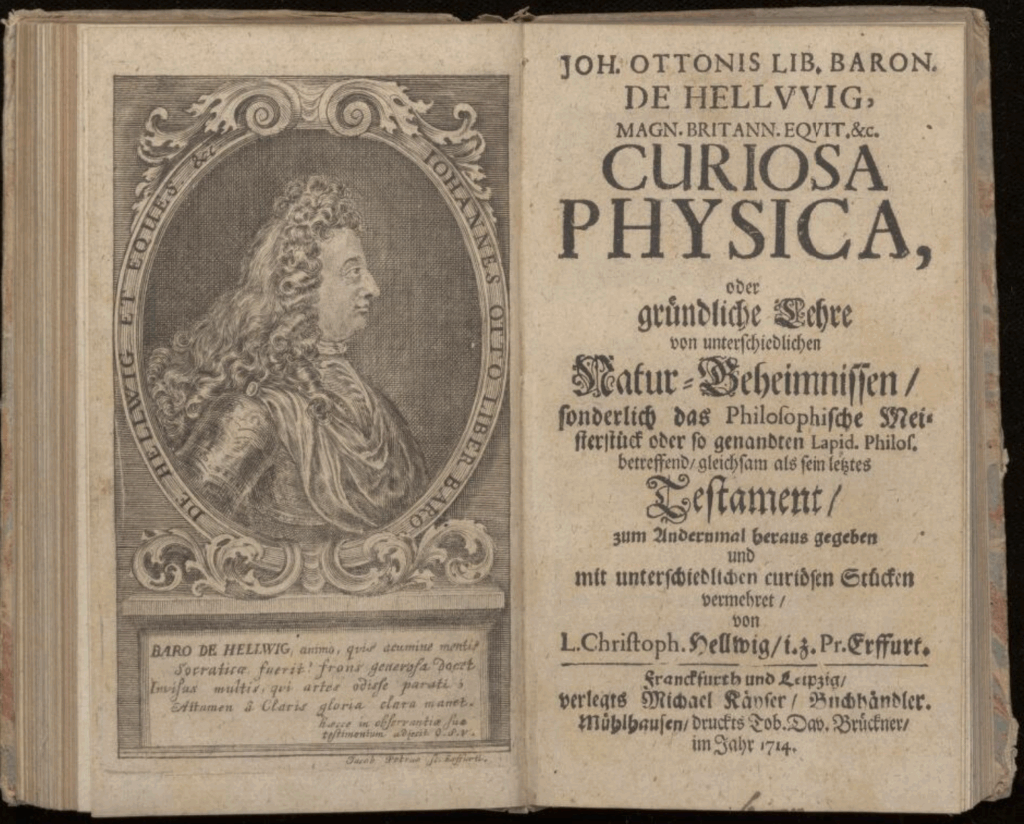
Curiosa Physica

I want to tell you about a library in Amsterdam housed in a 17th-century building called the House with the Heads, funded in part by the author of The Da Vinci Code, with a collection that was granted UNESCO Memory of the World status in 2022, and whose digital archive you can browse for free from your couch right now.

The Bibliotheca Philosophica Hermetica — the Ritman Library, now housed at the Embassy of the Free Mind — contains roughly 30,000 titles on Western esotericism, mysticism, alchemy, astrology, Kabbalah, Rosicrucianism, and related traditions. In 2018, after Dan Brown donated €300,000 to fund the digitization project (he’d visited the library multiple times while researching The Lost Symbol and Inferno), the library launched what they called, with genuine wit, Hermetically Open: a free, publicly accessible digital archive of its rarest pre-1900 texts. As of 2025, 2,178 books are fully scanned and available online.

The collection includes the Corpus Hermeticum from 1472, Giordano Bruno’s work from 1584, the first printed visual representation of the Kabbalistic Tree of Life from 1516, alchemical manuscripts with intricate hand-drawn diagrams, and hundreds of texts in Latin, Dutch, German, French, and English that blur every boundary we’ve drawn between science, philosophy, theology, medicine, and magic.

My first thought when I found this collection was: this is exactly what I want students to encounter.


Why “Occult” Is the Wrong Frame for This

The word does its work on us. “Occult” conjures Halloween aesthetics and conspiracy theories, and it’s easy to dismiss the whole thing as fringe material with no serious application in a classroom.

That reaction, though, says more about our current assumptions about knowledge than it says about these texts.

For several centuries of Western intellectual history, there was no clean dividing line between alchemy and chemistry, between astrology and astronomy, between hermetic philosophy and natural science. Isaac Newton — who gave us calculus, the laws of motion, and the theory of universal gravitation — spent at least as much of his intellectual energy on alchemy and Biblical prophecy as he did on physics. His alchemical manuscripts are available online too, through Cambridge’s digital library. The man who arguably launched the scientific revolution was also, by any contemporary definition, deeply engaged in occult practice.

This isn’t an embarrassing footnote. It’s actually essential context for understanding how scientific knowledge develops — through the messy, often wrong, often ideologically entangled process of humans trying to make sense of the world with the conceptual tools they have available. The Ritman collection is a primary source archive for that story.

As a doctoral student who has spent years reading about how knowledge is constructed, organized, and transmitted, I find this collection genuinely thrilling. These books are where the medieval and the modern collide. They’re where you can see what people got wrong and what they got surprisingly right, often in the same text, often for reasons that have nothing to do with intelligence and everything to do with the conceptual frameworks available to them.

That’s exactly what I want students to sit with.


What Makes This Useful for Teachers

The collection isn’t neat. It’s multilingual, dense, and built for scholars. That’s part of the point — it’s not pre-digested curriculum content, it’s actual historical material that requires work to interpret. For teachers who believe students should wrestle with primary sources rather than always receiving polished summaries of them, this is a goldmine.

A few ways I’d use this across disciplines:

History and Social Studies — Trace how alchemy became chemistry. Look at how astrology shaped political decisions in early modern Europe. Ask students why the intellectual tradition represented here was systematically excluded from what we now call the history of science, and what that exclusion says about how we decide what counts as legitimate knowledge.

English and Literature — The visual and linguistic strangeness of these texts is remarkable. The archaic spellings, the “long s” that looks like an f, the allegorical imagery, the blend of Latin and vernacular — all of it offers material for close reading and for connecting to the Gothic, Romantic, and magical realist traditions that drew heavily from this well.

Science — Contrast alchemical “recipes” with modern chemical procedures. Examine how flawed models of the cosmos were still generative — the people using them weren’t stupid, they were working at the edge of what was knowable. What does that say about our own current models?

Art and Design — The illuminated manuscripts and alchemical diagrams in this collection are extraordinary visual objects. The symbolic language is dense and codified and genuinely beautiful. There’s serious material here for design history, visual communication, and semiotics.

Philosophy — The Hermetic tradition represents a sustained attempt to synthesize Greek philosophy, early Christian theology, Jewish mysticism, and natural observation into a unified account of reality. That synthesis didn’t work out the way its practitioners hoped. But the attempt itself raises questions about knowledge, interpretation, and the limits of any single framework for understanding the world — questions that don’t go away.

The cross-disciplinary angle is what I find most powerful. One of the things that frustrated me most in my years as an educator before moving into instructional coaching is how thoroughly we’ve siloed knowledge. Students take chemistry, history, and English as separate things, as if the history of chemistry weren’t fascinating, as if the literary history of science didn’t exist. The Ritman collection doesn’t respect those boundaries because it predates our drawing of them.


The Resource

The collection is free, fully accessible online, and searchable — though the search interface takes some patience. The direct link to the digital catalog is here. I’d recommend starting with the “Digital collection” page, which gives you some orientation before you dive in.

A few things worth knowing:

  • The majority of texts are in Latin, Dutch, German, or French. English-language texts exist, but aren’t the majority. For classroom use, this is actually an opportunity — translation, context-building, and working with unfamiliar material are valuable skills.
  • The image quality varies, but the rare and fragile items were prioritized for digitization, so many of the most valuable texts are well scanned.
  • The broader collection, which includes 30,000 titles and continues to grow, is housed at the Embassy of the Free Mind in Amsterdam. If you’re ever there, it’s worth visiting.

The collection earned UNESCO Memory of the World status in 2022, a designation UNESCO does not hand out lightly. This is genuinely important cultural heritage, now freely available to anyone with internet access. That’s remarkable.


Dan Brown’s novels that led him to the Ritman Library — The Lost Symbol and Inferno — both draw heavily on the kind of Hermetic and esoteric tradition documented in this collection. If you want a somewhat lurid but surprisingly well-researched tour of the ideas, they’re a decent starting point. Brown is not a subtle writer, but he did his homework.


Related on this site: the AI books post covers how knowledge evolves and what it means to think critically about the tools we use — a thread that runs directly through what this collection makes visible.

What Teachers Need to Understand About AI and the Economy — A Reading List

man using laptop wit chat gpt
Photo by Matheus Bertelli on Pexels.com

Here’s something that should be keeping school leaders up at night: 55% of recent graduates report that their academic programs didn’t prepare them to use generative AI tools in the workforce. Not just use AI well — use it at all. We are preparing students for an economy that is reorganizing itself faster than our curriculum review cycles can keep up with, and most schools are responding with either panic or denial.

The World Economic Forum’s Future of Jobs Report 2025 projects that AI will displace 92 million jobs while creating 170 million new ones — a net gain on paper, but that math only works if the people losing the 92 million jobs can access the 170 million new ones. That transition requires education, retraining, and policy infrastructure that does not currently exist at the scale needed. Young workers in AI-exposed occupations are already experiencing shifts in employment. The college wage premium has flattened. Jobs requiring AI skills now command a 56% wage premium over those that don’t — up from 25% just the year before.

This is not an abstract future problem. It is the context in which our students will graduate.

I don’t write primarily about business or economics — this site is about education, technology, and the ideas that shape both. But understanding how AI is disrupting the economy is part of understanding what we are actually preparing students for. The books below are the ones I’d put in front of any educator or school leader who wants to think more seriously about this.


The Coming Wave: Technology, Power, and the Twenty-First Century’s Greatest Dilemma — Mustafa Suleyman

Get it on Amazon

Suleyman co-founded DeepMind (later acquired by Google) and Inflection AI before becoming CEO of Microsoft AI. He is, in other words, someone who has been building this technology from the ground up and who has had to think carefully about what he was building.

The Coming Wave is his argument that we are facing a genuine inflection point: AI and synthetic biology are advancing faster than governance structures can keep pace with, and the window to build appropriate containment mechanisms is closing. His central concern isn’t that AI is malevolent — it’s that the concentration of power that comes with controlling transformative technology is itself the problem, whether that power sits with corporations, governments, or both.

For educators: the chapter on economic disruption is essential reading. Suleyman doesn’t pretend the transition will be smooth. He takes seriously the question of what happens to people and communities during the displacement phase, which is precisely the phase our current students are entering.


AI Superpowers: China, Silicon Valley, and the New World Order — Kai-Fu Lee

Get it on Amazon

Lee has a unique vantage point: he’s worked at Apple, Microsoft, and Google, and then moved to Beijing to lead Google China before becoming one of China’s leading AI investors. AI Superpowers was published in 2018, and some of the specific competitive dynamics have shifted, but the core argument holds: we are in a global race for AI dominance between two different models of how AI development should work, and the outcomes of that race will have profound economic consequences at every level.

The section on job displacement is where this book becomes most directly relevant to educators. Lee argues that routine cognitive work is the most vulnerable to automation — not just manual labor — and that the categories of work that will be protected are those requiring creativity, empathy, and complex human judgment. That framing has direct implications for what we teach and why.

Read this alongside The Coming Wave for a richer picture of the geopolitical and economic forces shaping the AI landscape.


Prediction Machines: The Simple Economics of Artificial Intelligence — Ajay Agrawal, Joshua Gans & Avi Goldfarb

Get it on Amazon

Three economists from the University of Toronto built their framework around a deceptively simple claim: AI is, fundamentally, a technology that makes prediction cheaper. When prediction gets cheaper, the value of the things that complement prediction — judgment, action, data — increases. When prediction gets cheaper, the value of things that substitute for prediction — routine rule-following, low-stakes decision-making — decreases.

This framework is useful for educators because it maps directly onto a question we should be asking about curriculum: what are we teaching students that will be substituted by cheap AI prediction, and what are we teaching them that will be complemented by it? The answer has real implications for what genuinely rigorous education looks like in an AI economy. Prediction Machines is the most analytically useful book on this list for thinking through those questions.


The Age of AI: And Our Human Future — Henry Kissinger, Eric Schmidt & Daniel Huttenlocher

Get it on Amazon

An unusual collaboration: a former Secretary of State, a former Google CEO, and an MIT computer scientist thinking together about what AI means for how human societies understand the world. The book is less about the economic disruption and more about the epistemological one — the way AI systems generate outputs that humans can use without understanding how those outputs were produced, and what that does to decision-making in business, government, and education.

The argument that lands hardest for me as an educator: we have spent centuries building institutions of learning around the transmission and evaluation of human knowledge. AI is producing a new kind of knowledge — statistical, pattern-based, extraordinarily capable, and fundamentally alien to how human minds work. What does education mean in that context? This book doesn’t fully answer the question, but it asks it more precisely than most.


Power and Prediction: The Disruptive Economics of Artificial Intelligence — Ajay Agrawal, Joshua Gans & Avi Goldfarb

Get it on Amazon

The follow-up to Prediction Machines, published in 2022, moves from “here’s what AI does to economics” to “here’s how organizations and institutions will be restructured by it.” The core new argument: AI doesn’t just automate tasks; it disrupts the decision-making systems in which those tasks are embedded. That disruption creates power shifts — between professions, between institutions, between incumbents and challengers.

The education implications are direct. The authors discuss healthcare and legal services as sectors being restructured by AI-driven prediction, and the analysis applies equally to education. What happens to the teacher’s role when AI can provide personalized feedback faster and at greater scale? What happens to credentialing when AI can assess competencies that diplomas approximate? These aren’t comfortable questions, but they’re the right ones to be asking now rather than after the disruption has already happened.


The Question Underneath All of These Books

The books above are written primarily for business leaders, policymakers, and economists. That’s who they were designed for. But they all circle around a fundamentally educational question: what kind of people do we need to develop, and what do we need to prepare them for, in an economy being reorganized by AI?

Self-Determination Theory gives us part of the answer — humans are most resilient and most capable when they have genuine autonomy, a sense of competence, and meaningful connection. Those psychological needs don’t get automated. They get more important as the tasks around them do.

The Connectivist framing that the network is where knowledge lives is also useful here: in an economy where AI can provide information faster than any human, the competitive advantage lies in the quality of your connections — to ideas, to people, to problems worth solving — and in your capacity to navigate those networks with judgment. That’s what education in an AI economy should be building.

These books don’t answer those questions for us. But they describe the problem with enough precision that we can start asking the right ones.


Related on this site: the AI books post covers the books I’d recommend for understanding what AI actually is — how it works, what it can and can’t do, and what the most credible researchers think about its implications. That’s a companion list to this one.


The Eclectic Educator is a free resource for everyone passionate about education and creativity. If you enjoy the content and want to support the newsletter, consider becoming a paid subscriber. Your support helps keep the insights and inspiration coming!

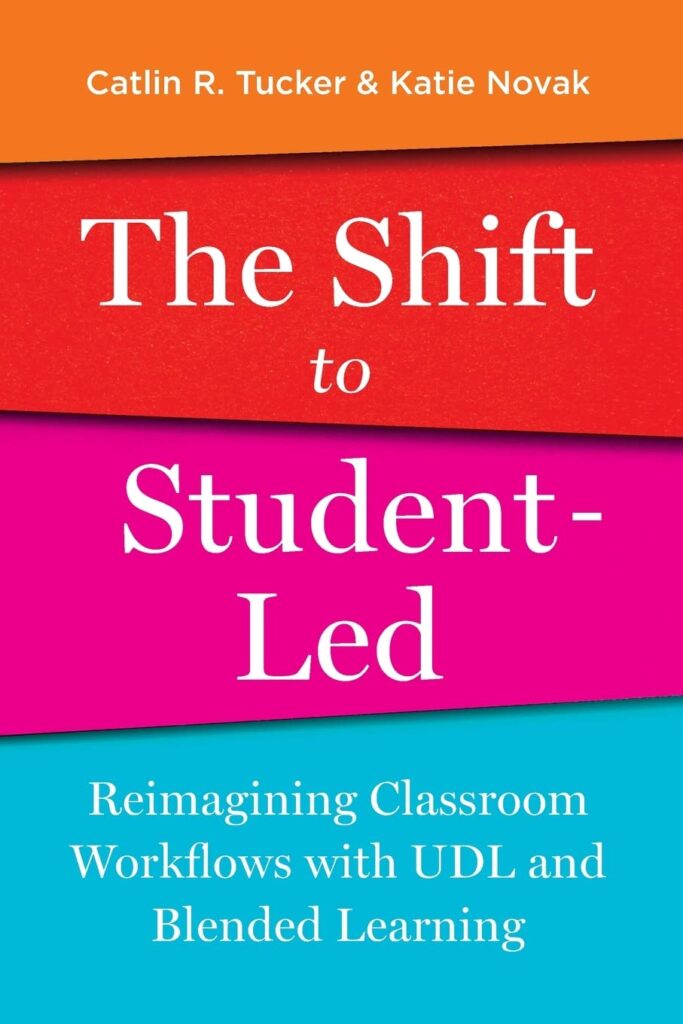
Book Review: The Shift to Student-Led by Catlin Tucker & Katie Novak

Reimagining the Classroom: The Shift to Student-Led with UDL & Blended Learning
Version 1.0.0

Here’s the thing nobody in education wants to say out loud: a significant portion of what we call “teaching” is actually just teachers doing the work that students should be doing.

Teachers write the summaries. Teachers generate the discussion questions. Teachers create the study materials. Teachers provide all the feedback. Teachers design all the reflection prompts. And then we wonder why students are passive, why engagement is low, and why teachers are burning out at alarming rates.

The Shift to Student-Led: Reimagining Classroom Workflows with UDL and Blended Learning by Catlin Tucker and Katie Novak is a direct response to this problem. As an instructional coach, I find myself recommending this book regularly — not because it’s revelatory, but because it articulates something that’s very hard to put into words in a 50-minute faculty meeting and then hands you tools to actually do something about it.


What the Book Is Actually About

Tucker and Novak are explicit about their starting point: they’ve worked with too many exhausted teachers. The context is post-pandemic education, where teachers who were already stretched thin absorbed years of additional uncertainty, disruption, and grief — and are now expected to simply resume as if none of that happened. The book isn’t optimistic about the status quo. It explicitly states that the current model isn’t sustainable and makes a structural argument for why.

The structural argument is this: when teachers are the primary workers in a classroom — the ones generating content, facilitating discussion, providing feedback, assessing progress — they create passive learners and exhausted professionals. The labor is distributed entirely wrong. Students are spectators in their own education, and teachers do a job that can’t be done by one person for 30 students without someone getting shortchanged. Usually, someone is the teacher.

The solution Tucker and Novak offer is to redistribute that labor through what they call student-led workflows — specific, structured shifts that move each of those teacher-dominated tasks back to students. Ten shifts in total, one per chapter, each paired with Universal Design for Learning (UDL) principles and blended learning strategies that make the shift manageable across a diverse classroom.


UDL and Blended Learning — Why These Two

The combination isn’t arbitrary. UDL addresses the persistent challenge of designing learning for the full range of students in a classroom without creating 30 different lesson plans. Its core principle — build flexibility and choice into the design from the start rather than retrofitting accommodations afterward — directly enables student agency. When multiple means of engagement, representation, and expression are built in, students can direct more of their learning because the options are available.

Blended learning addresses the logistics. Technology, when used intentionally, creates the structures that enable student-led workflows at scale. Not technology as a substitute for teaching, but technology as the infrastructure that lets students access content, track their own progress, collaborate asynchronously, and document their thinking in ways that a purely analog classroom can’t sustain.

Neither of these ideas is new. What Tucker and Novak do is show specifically how they work together to shift who does the work, which is a more practical frame than either concept provides on its own.


The Ten Shifts

The book’s ten workflows move through five areas: lessons, assessments, practice, feedback, and discussions. In each area, Tucker and Novak show what the teacher-led version looks like, what problems it creates, what the research suggests, and what a student-led version looks like with concrete examples and implementation tools.

A few that land particularly well in the coaching conversations I have:

From teacher-provided feedback to student self-assessment. This is the shift most teachers resist hardest, and most students need most. The book makes a compelling case that waiting for teacher feedback creates learned helplessness — students who can’t evaluate their own work are dependent on external validation in ways that don’t serve them in college, career, or life. The practical tools for building student capacity to assess their own work are among the most immediately usable in the book.

From teacher-led discussion to student-facilitated conversation. Whole-class discussions in which the teacher asks questions and students respond are a remarkably inefficient way to build thinking. Tucker and Novak offer structures — including protocols that can run entirely without teacher direction — that shift the facilitation to students. This one requires patience to implement; students who have been in teacher-led discussions their whole lives don’t immediately know how to facilitate for each other. But the payoff is substantial.

From teacher-created practice to peer-generated learning resources. When students create flashcards, summaries, or quiz questions for each other, they’re doing the cognitive work that actually builds retention. The teacher’s job shifts from resource creator to quality reviewer, which is a genuinely different and more sustainable role.


What It Gets Right

The book earns its positive reputation with practitioners primarily because it doesn’t just describe what student-led learning looks like — it walks through the implementation with enough specificity to actually try it. The templates and protocols are real, the scenarios are recognizable, and Tucker and Novak are honest that these shifts take time and that students will push back initially because passive learning is more comfortable in the short term.

The framing of teacher sustainability is also well handled. This isn’t positioned as “here’s how to do more for students” — it’s positioned as “here’s how to stop doing work that isn’t yours to do,” which is a meaningfully different message for a profession that has normalized unsustainable self-sacrifice.


What to Watch For

A couple of honest caveats from the coaching side of this.

The book is designed primarily for secondary and post-secondary classrooms, though the principles extend further. Elementary teachers will find more adaptation required.

As with most professional development books, the gap between reading the ideas and actually implementing them in the classroom is real. The templates help, but student-led workflows require significant upfront investment in building the routines and student capacity that make them work. The book is clear about this, but it’s easy to underestimate when reading.

And the blended learning components assume a level of access to technology and reliability that isn’t universal. The ideas hold without the technology, but the specific digital strategies require some translation for under-resourced classrooms.


Who Should Read This

Teachers who feel like they’re carrying their classrooms on their backs — this book is written directly for you, and the framing will be immediately recognizable.

Instructional coaches supporting teachers in designing more student-centered practice — I’d use this as a book study anchor and the companion resources as coaching tools.

School leaders thinking about what sustainable teaching practice actually looks like — the structural argument in the opening chapters is worth your time, even if you don’t go chapter by chapter through the workflows.


Get The Shift to Student-Led

Free resources from the authors:


Related on this site: the free play and Peter Gray post makes a parallel argument about who does the work of learning — and what happens to kids when adults take over tasks that should belong to them.

Why Do They Fear Dragons?

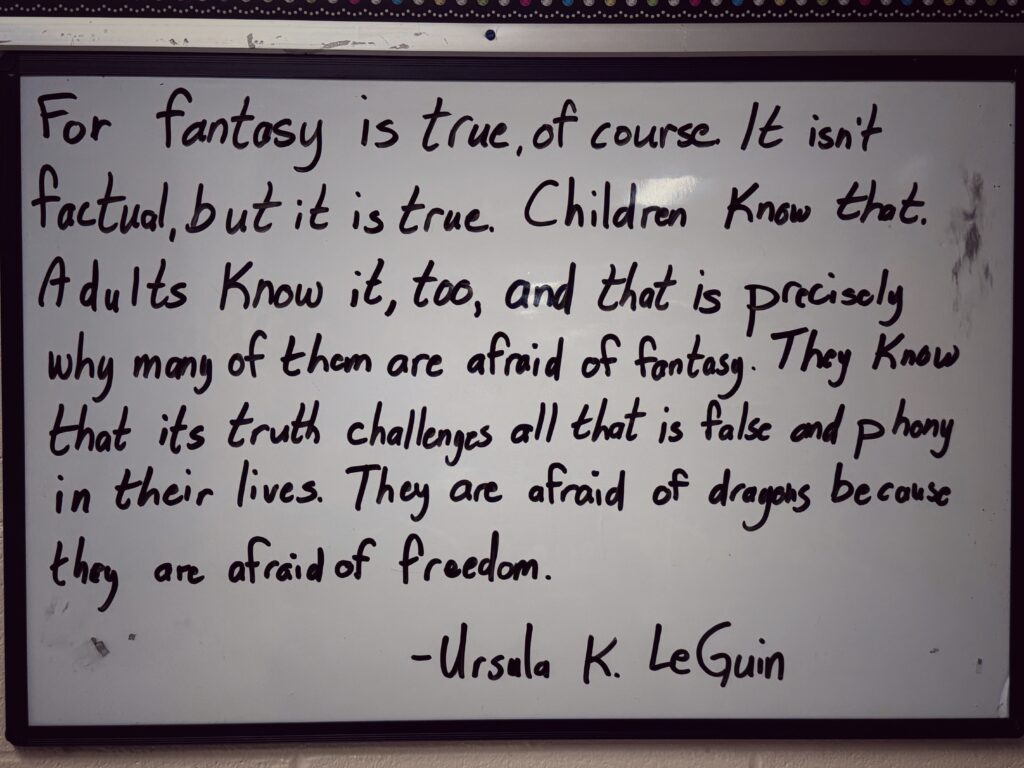
For fantasy is true, of course. It isn’t factual, but it is true. Children know that. Adults know it, too, and that is precisely why many of them are afraid of fantasy. They know that its truth challenges, even threatens, all that is false, all that is phony, unnecessary, and trivial in the life they have let themselves be forced into living. They are afraid of dragons because they are afraid of freedom.

I’ve been reading a lot of Ursula K. LeGuin lately. Whether or not it’s because I hadn’t read much of her work before I read The Dispossessed last year, I’m not sure. But I wish I had.

I’m working through her essays published in The Language of the Night and am transfixed by her words and thoughts.

She’s so fucking good.

As I watch the current state of the world play out and think about all the “bullies” who now sit in high political positions in our country, and I think back to my high school days and those bullies, there is a recurring constant: their hatred of all things fantastical.

And this Le Guin quote feels very appropriate for this moment:

For fantasy is true, of course. It isn’t factual, but it is true. Children know that. Adults know it, too, and that is precisely why many of them are afraid of fantasy. They know that its truth challenges, even threatens, all that is false, all that is phony, unnecessary, and trivial in the life they have let themselves be forced into living. They are afraid of dragons because they are afraid of freedom.


The Eclectic Educator is a free resource for everyone passionate about education and creativity. If you enjoy the content and want to support the newsletter, consider becoming a paid subscriber. Your support helps keep the insights and inspiration coming!
Daring Greatly: The Courage Manual You Didn’t Know You Needed

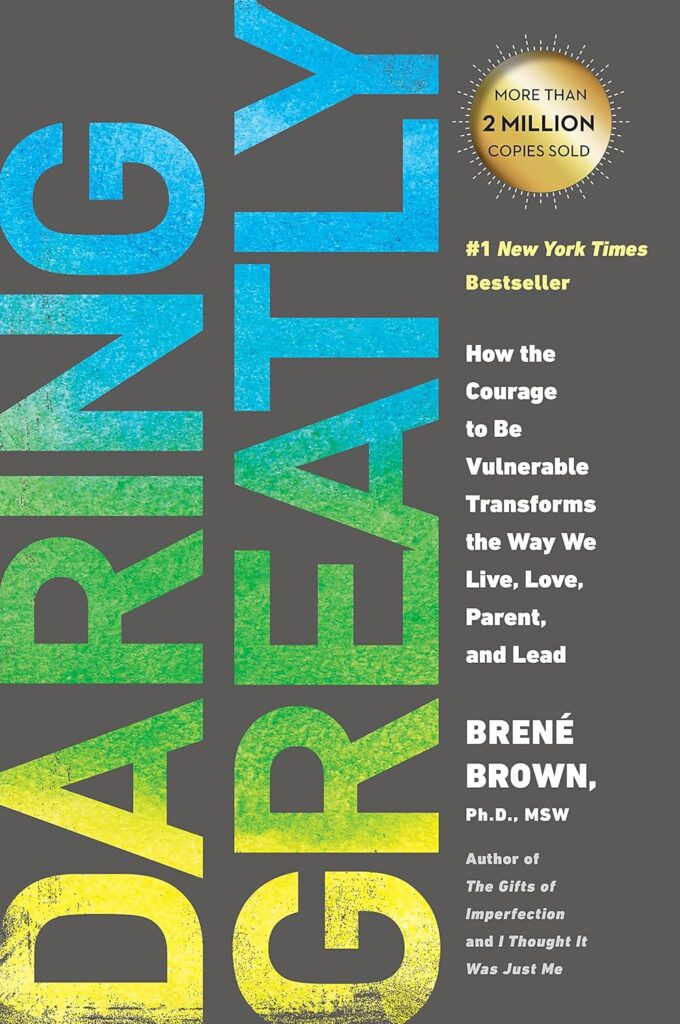
Daring Greatly

I want to be honest about my relationship with Daring Greatly before I say anything else, because I think it matters.

When Brené Brown’s TED talk went viral, I was skeptical. The vocabulary — vulnerability, wholehearted, shame resilience — sounded like the kind of therapeutic language that gets plastered on motivational posters and stripped of the difficult specificity that actually makes it useful. I’d seen the ideas travel from a research context to a corporate keynote to a school district “culture” initiative, losing precision at every step.

So I put off reading the book for longer than I should have.

I was wrong to. Daring Greatly is not what I expected. It’s a more rigorous, more honest, and more specifically useful book than the way it tends to be discussed. And for anyone who works in education — particularly anyone who coaches teachers, which requires asking adults to be vulnerable about their practice in ways that most professional norms actively discourage — it’s genuinely important.


What the Book Actually Is

Brown is a qualitative researcher who spent years studying connection, shame, and what she calls “wholeheartedness” — the capacity to engage fully in life despite uncertainty and imperfection. Daring Greatly is built on that research: real data, patterns from thousands of interviews, and a framework she developed to understand what gets in the way of genuine engagement.

The central claim is that vulnerability — defined as risk, emotional exposure, and uncertainty without guaranteed outcome — is not weakness. It is the precondition for courage, creativity, connection, and meaningful work. The armor we build to avoid vulnerability (perfectionism, cynicism, numbing, controlling) protects us in the short term and costs us everything in the long term.

The book is titled after a Theodore Roosevelt quote: the famous “man in the arena” passage, the one about the critic who sits in the cheap seats versus the person who is actually in the fight, who “dares greatly” even knowing they will fail sometimes. Brown uses it as a frame for what she’s asking: not to eliminate vulnerability, but to choose it deliberately, in service of what matters.


Why It Matters in Schools, Specifically

Teaching is one of the most vulnerable jobs there is, and we have almost no professional language for that.

Every day, teachers stand in front of 25 or 30 people and attempt to make something happen — understanding, curiosity, skill, connection — without any guarantee that it will work. The lesson they planned might fall flat. The explanation they thought was clear turned out to be confusing. A student they’ve been trying to reach for weeks shuts down at the one moment they feel like they’re finally getting through. This happens constantly, and mostly in silence, because the professional culture of teaching tends to reward certainty and penalize visible struggle.

As an instructional coach, a significant part of my work involves watching teachers teach — sitting in classrooms, observing, taking notes, then having conversations about what I saw. This is, if you think about it, a structured invitation to vulnerability. I’m asking a professional to let someone into the most imperfect part of their work, the part they haven’t figured out yet, and to talk about it honestly.

What Brown’s research makes clear is why this is so hard and why so many coaching relationships fail to produce genuine reflection: shame. Not dramatic shame, but the quiet, ambient kind — the professional fear that if you let someone see what’s not working, they’ll conclude that you are not working. That the struggle is evidence of inadequacy rather than evidence of honest effort in a genuinely difficult job.

Brown’s framework for navigating this — what she calls shame resilience, the capacity to recognize shame, reality-check the story you’re telling yourself, reach out, and speak it rather than let it drive behavior — is a practical map for conversations that coaching depends on. It’s not therapeutic language. It’s a professional development infrastructure.


The Research Versus the Brand

Here’s my honest caveat, because this book has a complicated position in the culture.

The research underlying Daring Greatly is real and legitimate. Brown’s qualitative work is careful, and her framework is grounded in patterns observed among real people. The book respects the reader’s intelligence.

But Brown has also become a brand, and the brand version of these ideas is considerably more diluted than the book version. The corporate keynote version of “vulnerability” often means “share something personal at the start of a meeting to build rapport,” which is not what Brown is describing. The school culture version tends to mean “hang growth mindset posters and say ‘we value failure,'” which is also not what Brown is describing.

The book itself is more demanding than that. It’s asking for something that is genuinely uncomfortable: not performed openness but actual risk. Not vulnerability as a tactic, but vulnerability as a condition of meaningful work. There’s a significant difference, and if you’ve been exposed to the brand version without the book version, the book may surprise you with how much harder it asks you to be on yourself.


What Resonates as an Educator

A few things from this reread that I keep thinking about:

The distinction between perfectionism and high standards. Brown is not arguing against excellence. She’s arguing against the specific cognitive trap of using perfectionism as a protective strategy — the belief that if you do everything perfectly, you can avoid criticism, judgment, and failure. That trap is everywhere in teaching and education leadership, and it produces exactly the opposite of what it promises.

The concept of “foreboding joy.” The tendency to preemptively imagine disaster when things are going well — to hold back from full engagement because full engagement feels dangerous. Teachers who’ve been through painful years sometimes develop this reflex: don’t get attached to a good moment because it will end. It’s a real pattern, and Brown names it precisely.

The arena metaphor is applied to professional learning. The person in the arena is the teacher who tries something new, has it fall apart in front of their students, and then learns from it. The person in the cheap seats is anyone who critiques without attempting. School cultures that penalize visible struggle and reward only polished performance push people out of the arena and into the cheap seats — and then wonder why professional learning doesn’t stick.


Who Should Read This

If you coach teachers or lead professional development, this book will give you a framework for understanding why the work is harder than it looks and what the emotional conditions for genuine growth actually require. Read it before you design your next coaching cycle.

If you’re a teacher who’s been in the profession long enough to have developed professional armor — the particular efficiency and distance that protects you from full engagement — this book will name what’s happening with more precision than most things you’ll find in education-specific reading.

If you’re skeptical of self-help books in general (I was), give the first three chapters a try before deciding. It earns its keep.

Rating: 4 out of 5. The research is real, the framework is useful, and the writing is clear without being condescending. The half-star off is because some sections drift toward the brand territory — the motivational phrasing that feels more like it was designed for an audience than worked out for a reader. The core is worth it.

Get Daring Greatly


If You Liked This, Read Next

Dare to Lead by Brené Brown — Brown’s follow-up focuses on leadership and organizations rather than on individuals. More directly applicable to school leaders and coaches.

The Gifts of Imperfection by Brené Brown — The book that preceded Daring Greatly, covering many of the same ideas with more focus on personal life than professional. A good companion.

Mindset by Carol Dweck — The growth mindset research that maps directly onto what Brown is describing about perfectionism and failure. Read together, they’re more useful than either is alone. (Affiliate link)

The Shift to Student-Led by Tucker and Novak — Connects Brown’s ideas about vulnerability and risk to the classroom specifically: what it actually means to create conditions where students (and teachers) can fail productively. (Affiliate link)


Related on this site: the Mastery post covers the long arc of skill development in teaching. Brown and Greene are in conversation, whether they know it or not — Brown asks what makes it possible to keep showing up to hard work, Greene asks what happens when you do.


The Eclectic Educator is a free resource for everyone passionate about education and creativity. If you enjoy the content and want to support the newsletter, consider becoming a paid subscriber. Your support helps keep the insights and inspiration coming!
Neuromancer Book Review: The book that jailbreaks the future

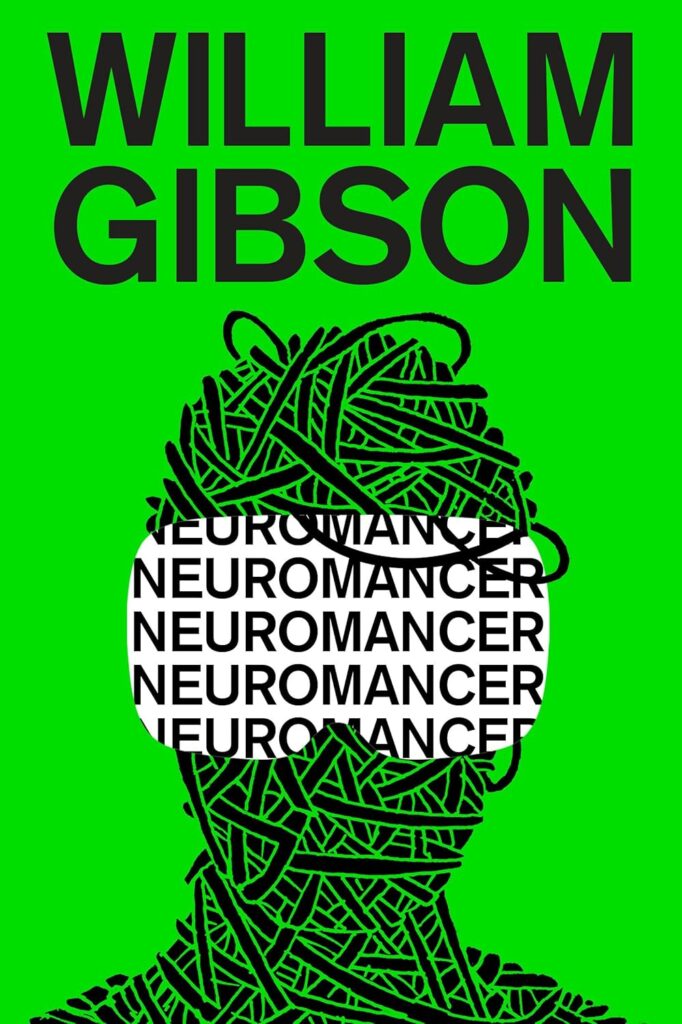
Neuromancer cover

I’ve read Neuromancer several times over the years. It’s one of those books that sits differently depending on when in your life you encounter it — and what’s happening in the world around you when you do. (Affiliate link)

The prompt for this most recent reread was hearing that Apple TV+ has finally greenlit a proper adaptation — 10 episodes, created by Graham Roland and J.D. Dillard, with Callum Turner as Case and Briana Middleton as Molly, plus Mark Strong, Peter Sarsgaard, and Dane DeHaan in supporting roles. Production started in July 2025 on the book’s 41st anniversary, filming across Tokyo, Los Angeles, Istanbul, London, and Canada. No official release date yet, but 2026 seems likely. The teaser they released showed Bar Chatsubo coming to life — neon sign buzzing on, pinball machines dinging — and it looked exactly right.

I wanted to go back to the source before the adaptation arrives and reminds me that an adaptation is never the thing itself.

It was published in 1984. Gibson wrote it on a manual typewriter with almost no experience with computers. And he invented the word “cyberspace,” described something functionally identical to the internet before the internet was publicly accessible, depicted AI alignment concerns that we are actively litigating in real boardrooms and research labs right now, and built a corporate power structure that reads less like science fiction and more like a terms-of-service agreement from 2026.

That’s not a small thing. It’s also not an accident — it’s the result of a particular kind of thinking that the book rewards you for trying to understand.


The Setup, for Those Coming to It Fresh

Coming back to the book, knowing what happens, certain things land differently. But for anyone who hasn’t read it yet — and with the show coming, there will be a wave of those — here’s what you’re getting into.

Case is a burned-out hacker — Gibson calls him a “console cowboy” — who used to be able to “jack into” cyberspace, a shared consensual hallucination where data has physical form and geography. He was caught stealing from his employers, who punished him by chemically destroying his ability to interface with the matrix. Now he’s stuck in his body, in Chiba City, slowly falling apart.

He gets one more shot. A mysterious employer named Armitage hires him for a heist: reassemble a crew, hit a series of increasingly dangerous targets in cyberspace and in the physical world, and ultimately go after something enormous — two artificial intelligences that may or may not be trying to merge into something the law explicitly prohibits.

Molly Millions, the street samurai with mirrored eyes and retractable razors under her fingernails, is his partner. She is one of the great characters in science fiction, and the book treats her as a full human being navigating a world that consistently tries to reduce her to a tool, which Gibson handles better than you might expect from a 1984 novel.

The plot is propulsive, dense, and sometimes deliberately opaque. Gibson trusts you to catch up. You will.


What the Book Actually Got Right

Reading Neuromancer in 2025, what strikes me most isn’t the predictions — though those are remarkable — it’s the logic Gibson built, and how much of that logic turned out to be structurally accurate.

He understood that information would be power in ways that would look like physical geography. Cyberspace has terrain, fortifications, and controlled access points. This is exactly how we now experience the internet — as something navigable, where access is granted or denied, where some spaces are surveilled, and some are dark. The metaphor taught us how to think about it before it existed.

He understood that corporations would become more powerful than states in the digital domain. The megacorps of Neuromancer — Tessier-Ashpool, the Maas-Neotek entities — function as sovereign entities with their own security forces, justice, and ethics. This reads less like dystopian speculation and more like a description of the relationship between major tech platforms and national governments right now.

He understood that AI alignment would be the central problem. Wintermute and Neuromancer, the two AIs at the center of the heist, are constrained by the Turing police and by hardware limitations specifically to prevent them from becoming something ungovernable. What happens when those constraints break down is the spine of the novel. This is not a metaphor. This is the actual debate happening in AI safety research today.

He understood that the body would become a site of modification and upgrade. Molly’s implants, the black-clinic surgeries, the chemical modifications people undergo to perform different functions — all of this prefigures the wearables, the biohacking communities, the pharmacological self-optimization that has become ordinary. The body as firmware, subject to patches.

None of this was inevitable or obvious in 1984. Gibson got there through instinct, extrapolation, and a particular kind of lateral thinking that is worth taking seriously.


The Prose Is Genuinely Good

This matters because much foundational science fiction is more important than it is pleasurable to read. Neuromancer is both. Gibson writes with compression and precision — he loads each sentence with atmosphere rather than explanation, trusts the cumulative effect rather than stopping to define his terms, and moves the narrative at a pace that makes the density feel earned rather than punishing.

The opening line — “The sky above the port was the color of television, tuned to a dead channel” — is one of the most famous sentences in the genre. It’s famous because it works. It establishes the world’s aesthetic, the narrator’s sensibility, and the specific quality of deadness that saturates the setting, all in seventeen words. The prose sustains that quality across 300 pages, which is not easy.


Why It Matters Now, Specifically

I came to this book thinking it was primarily a historical artifact — important to have read, the way you feel about certain canonical texts. That’s not how it landed.

We are living through a genuine inflection in how AI is developed, deployed, and governed, and we are doing it largely with conceptual tools that Gibson helped build. When we talk about “jacking into” a system, when we describe AI as having “alignment” problems, when we frame digital spaces as places you can enter and exit, be surveilled within, be locked out of — that is Gibson’s grammar. Understanding where it came from helps you use it more critically.

For educators and technologists in particular, the questions at the center of Neuromancer — about AI autonomy, about corporate power over digital infrastructure, about what it means for humans to be continuous with their tools — are not settled. The book doesn’t settle them. But it frames them in ways that are still useful, which is more than most 40-year-old fiction can claim.


The Honest Caveats

The novel has real weaknesses alongside its achievements. The women characters, particularly the female AIs and some supporting figures, vary considerably in how fully realized they are — Molly is exceptional, but the book doesn’t consistently apply the same care to other female characters.

Some of the plot mechanics require patience. Gibson is not interested in exposition. There are passages in the middle third where the reader is expected to hold considerable ambiguity and track multiple layers of shifting allegiance simultaneously. This is part of the experience, but it’s not frictionless.

The cyberpunk aesthetic Gibson created has since been so thoroughly replicated, parodied, and commercialized that approaching the original can feel like watching a band whose sound has been copied by a hundred acts. Some of the freshness is gone because it’s been everywhere. Reading it as an artifact rather than a discovery takes conscious effort.


On the Apple TV+ Adaptation

Neuromancer has been called unfilmable for four decades — not because the story is too strange, but because so much of its texture lives in the prose itself. The sensation of jacking into cyberspace, the specific quality of Chiba City at night, the density of Gibson’s metaphors — these are things that work on the page in ways that don’t automatically translate to a screen.

The cast gives me real hope. Callum Turner has the worn-down intensity that Case requires. Briana Middleton as Molly is intriguing casting — she’s been excellent in everything I’ve seen her in, and Molly is the character the adaptation most needs to get right. Dane DeHaan as Riviera is inspired: Riviera is one of fiction’s great unhinged narcissists, and DeHaan has been waiting for a role this strange.

The showrunner is Graham Roland, who co-created Jack Ryan, and the pilot director is J.D. Dillard, whose work has shown genuine visual intelligence. They’ve been filming in Tokyo, Los Angeles, Istanbul, London, and Canada — which suggests they’re taking the world-building seriously rather than building it entirely on a soundstage.

The thing Gibson himself said is worth holding onto: an adaptation isn’t the book, and shouldn’t try to be. “A novel is a solitary creation. An adaptation is a fundamentally collaborative creation.” He’s right. The best version of a Neuromancer show isn’t a faithful recreation — it’s something that captures what the book does rather than what it says. Whether Roland and Dillard found that is the question the show will answer.

Either way: read the book first. Not because the show will ruin it — adaptations rarely do — but because the book is doing things that no 10-episode series can fully replicate, and you want to have had that experience on its own terms.


Rating: 4.5 out of 5

Essential. Dense. Genuinely worth the effort to sit with rather than skim. The half-star off is for the uneven treatment of secondary characters and the occasional opacity in the middle section. The 4.5 is for inventing a world so accurately that we’re still living in the first draft of it.

Get Neuromancer


If You Liked This, Read Next

Count Zero by William Gibson — The immediate sequel, set in the same world a few years later. Different protagonists, a broader canvas, and, in some ways, more accessible than Neuromancer.

Snow Crash by Neal Stephenson — The other foundational cyberpunk novel, published in 1992, which invented the terms “metaverse” and “avatar” and is considerably funnier than Gibson. If Neuromancer is the dark, serious version, Snow Crash is the sharp, satirical one. Both are essential.

Burning Chrome by William Gibson — A short story collection that includes some of Gibson’s best work and the original story in which “cyberspace” first appeared.

The Lifecycle of Software Objects by Ted Chiang — A novella that asks many of the same questions about AI autonomy and attachment that Neuromancer raises, but from a more intimate and emotionally direct angle. Written in 2010, but feels more current with each passing year.


If you’re reading this in the context of thinking about AI and technology, the AI books post covers the non-fiction I’d pair with Gibson’s fiction: Mollick, Suleyman, and Crawford. The fictional imagination and the analytical one sharpen each other.


The Eclectic Educator is a free resource for everyone passionate about education and creativity. If you enjoy the content and want to support the newsletter, consider becoming a paid subscriber. Your support helps keep the insights and inspiration coming!
Book Review: Tomorrow, and Tomorrow, and Tomorrow by Gabrielle Zevin

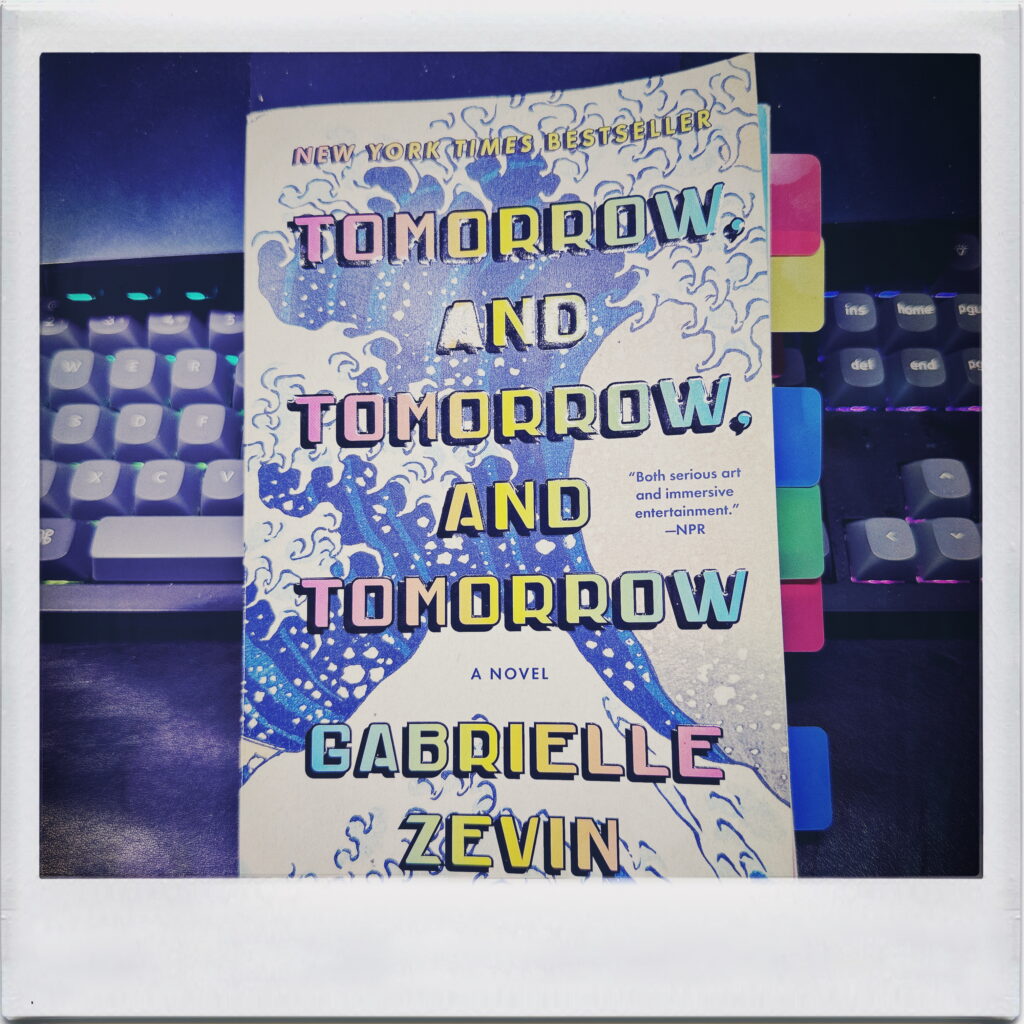
book cover

I read this book over the summer, in that particular state of rest that July occasionally allows — the one that educators know well, when the school year is genuinely far enough away that you can read for pleasure without it feeling like time you should be spending on something else.

Tomorrow, and Tomorrow, and Tomorrow by Gabrielle Zevin sat on my TBR for a while because I was skeptical. A literary novel about video game designers. The hype was enormous. The overlap between “prestige literary fiction” and “video game culture” felt like it might produce something condescending to both.

It didn’t.


What It’s About

Sam Masur and Sadie Green first meet as children in a hospital, bonding over video games while Sam is recovering from a car accident that has shattered his foot. The friendship deepens, fractures, and then reforms years later when they encounter each other again in college — and discover they can make something together that neither could make alone.

The book spans thirty years and three coasts, following Sam and Sadie as they build a series of video games, a company, a complicated creative partnership, and a relationship that is one of the most fully realized portrayals of deep friendship I’ve read in recent fiction. Marx, Sam’s roommate who becomes their producer and eventually Sadie’s partner, is the third point of the triangle — generous, perceptive, and ultimately the character whose absence reshapes everything.

Zevin structures the novel partly around the games Sam and Sadie create, which mirror their emotional states and the health of their relationship. It’s a formal choice that shouldn’t work as well as it does. The games are real in the way fictional technology rarely feels real — specific, idiosyncratic, built with apparent care rather than gestured at.


The Macbeth Problem (or Gift)

The title comes from the “tomorrow, and tomorrow, and tomorrow” speech in Macbeth — one of the most despairing passages in Shakespeare. Macbeth, after his wife’s death, catalogs the emptiness of time, the way tomorrow keeps arriving and delivering nothing but more of the same meaninglessness.

Here’s Patrick Stewart’s take from a modern interpretation of Macbeth:

Zevin takes this and inverts it. The “tomorrows” in her novel are not nihilistic. They are the respawns — the new game, the fresh start, the decision to keep playing after failure. The book is in conversation with the speech in a way that isn’t heavy-handed: the reference illuminates without dominating.

For educators, and I’m thinking here specifically about what it means to start a new school year, this inversion lands differently than it might for other readers. Every August is a tomorrow in exactly Zevin’s sense. Not the Macbeth sense — not emptiness recycling — but the choice to come back to something you believe in, again, after whatever last year held. That’s not a small thing to name.


What the Book Gets Right

Zevin is excellent on the texture of creative partnership — the way collaboration requires vulnerability, the way credit becomes a site of injury, the way people who make things together can genuinely love each other and also genuinely damage each other through the work. The professional and the personal don’t separate cleanly in Sam and Sadie’s relationship, and Zevin doesn’t pretend they should.

The treatment of disability is careful and specific. Sam’s foot injury — which eventually leads to amputation — is present throughout the book not as a symbol but as a lived reality that shapes his movement, his endurance, his relationship to physical space and physical pain. It’s not the defining fact of his character, but it’s not invisible either.

The friendship itself, which Zevin consistently describes as love without romance, is the novel’s real subject and greatest achievement. Sam and Sadie are “often in love, but never lovers” — and Zevin makes that distinction feel earned rather than coy. The question the book refuses to answer is whether their relationship would have been better or worse if it had become romantic, and the refusal feels honest rather than evasive.


What Doesn’t Quite Land

The novel is long and sometimes diffuse. Zevin covers thirty years of characters’ lives across multiple coasts and collaborations, and the middle section loses momentum in ways the beginning and end don’t. Some readers will find this immersive; others will find it baggy.

Some of the secondary characters — particularly the antagonists — function more as plot machinery than people. The novel’s sympathies are clearly with Sam and Sadie, and the characters who create obstacles for them occasionally feel as though they exist solely for that purpose rather than as full human beings.

The tech industry milieu is well-rendered but could have pushed harder on the structural inequities of creative industries. Sadie’s experience as a woman in gaming is addressed but somewhat lightly — a few scenes of credit being stolen, a few moments of being underestimated — in ways that feel like acknowledgment rather than full engagement.


Why I Kept Thinking About It

The reason this book stayed with me into August and into the start of the school year is the question at its center: what does it mean to keep making things together, across setbacks, failures, and the wreckage of what didn’t work?

The games Sam and Sadie build aren’t perfect. Some are failures. Some succeed in ways that create new problems. The process is recursive, sometimes painful, and never finished. And they keep doing it because the alternative — not making anything, not collaborating, not returning to the relationship even when it’s been damaged — is worse.

That’s not a bad frame for teaching. Or for any work that asks you to keep showing up to something that matters, in partnership with other people, over the years.

Rating: 4.5 out of 5 stars.

Get Tomorrow, and Tomorrow, and Tomorrow


If You Liked This, Read Next

A Little Life by Hanya Yanagihara — The other major literary novel of the last decade about a decades-spanning friendship between creative people. Significantly darker and more harrowing than Zevin’s novel. If you can handle it, it’s extraordinary.

The Midnight Library by Matt Haig — The most direct overlap on the “what if you could respawn, what lives might you have lived” question. Lighter than Zevin, more explicitly hopeful, and a genuinely affecting read.

Piranesi by Susanna Clarke — Another novel about navigating an invented world with its own strange rules, and what it means to find meaning and connection inside a reality that isn’t quite the ordinary one. Very different in tone from Zevin, but shares something with the game-as-parallel-world structure.

Klara and the Sun by Kazuo Ishiguro — A novel about observation, loyalty, and the limits of understanding the people you care most about. Quieter than Zevin but similarly interested in the question of what we owe to the people we love.


I also wrote a newsletter piece that blends this book with Shakespeare’s Macbeth and Jane McGonigal’s Reality is Broken, reflecting on what the “respawn” metaphor means for educators heading into a new school year. Read it here →


The Eclectic Educator is a free resource for everyone passionate about education and creativity. If you enjoy the content and want to support the newsletter, consider becoming a paid subscriber. Your support helps keep the insights and inspiration coming!