There is a moment about a third of the way into Of Monsters and Mainframes where the ship’s navigational AI — Demeter, our narrator — is trying to process the fact that she apparently cannot see one of her passengers on any of her internal cameras. The passenger exists; she knows this because other sensors can detect body heat and mass displacement. But the cameras see nothing.
The reason, which Demeter arrives at through a chain of logic that is both entirely reasonable and completely deranged, is that her passenger doesn’t have a reflection. And the reason that is relevant is something she refuses to log, because her programming explicitly prohibits her from recording events that are impossible.
Vampires are impossible. Therefore, there are no vampires aboard. The cameras are malfunctioning. Maintenance ticket submitted.
That is the energy of this entire book, and I loved every page.
What It Is
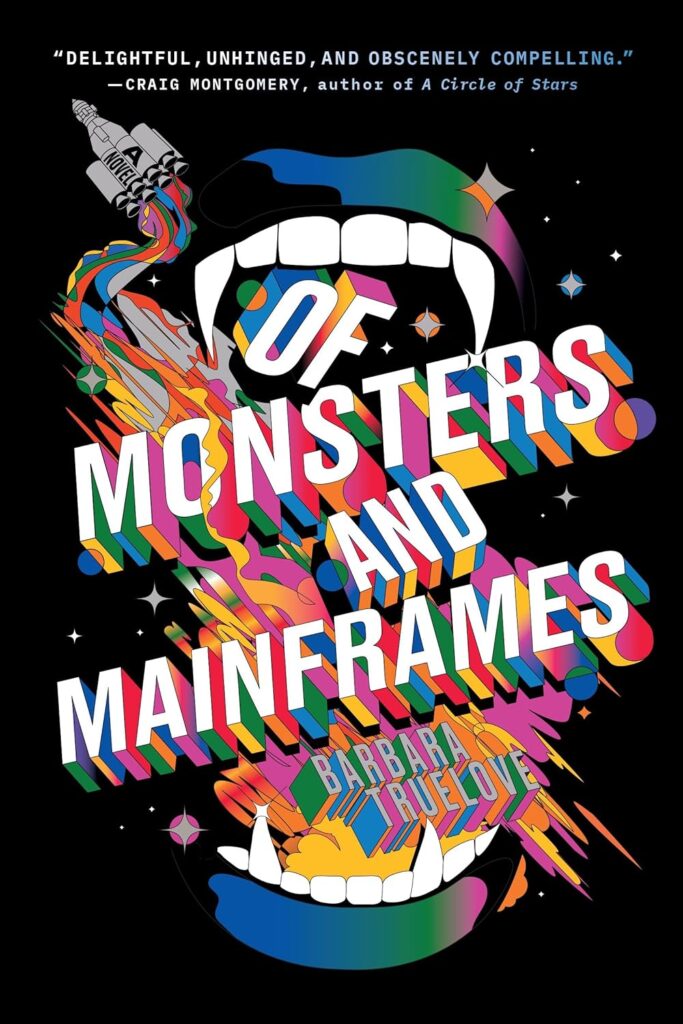
Of Monsters and Mainframes is Barbara Truelove’s debut novel, published in June 2025. The premise: it’s the year 2371, and Demeter is the AI navigator of an aging passenger liner running between Earth and Alpha Centauri. Her job is routine. Her passengers keep dying in impossible ways. She keeps filing maintenance tickets.
After the first incident — all 312 passengers dead, ship’s logs showing nothing, two traumatized children somehow alive — Demeter spends a few years in quarantine storage while investigators try to figure out what happened. When they can’t, they send her back out. The second voyage goes worse. And so on, through an escalating series of encounters with things that Demeter’s programming insists do not exist: Dracula, a werewolf, an engineer assembled from parts, a pharaoh with cosmological powers, and a group of passengers slowly and enthusiastically converting into Deep Ones.
Eventually, Demeter assembles all of them — the monsters, the children, the fussy medical AI Steward who has been her reluctant partner through all of this — into an undead A-Team and points them at the problem.
The problem is still Dracula.
Why It Works
The obvious comparison is Murderbot — Martha Wells’s reluctant hero with an AI narrator who would rather be left alone to watch TV serials than deal with humans — and it’s fair. Demeter shares that voice: the dry observation, the anxiety, the way bureaucratic language keeps colliding with impossible situations. (“Exsanguination — cause undetermined. Passengers deceased: 312. Maintenance tickets filed: 47.”)
But Of Monsters and Mainframes has something Murderbot doesn’t: genuine camp. Truelove is clearly having a blast. The book knows it’s absurd and leans into it without ever becoming a parody. When a werewolf has to navigate zero-gravity corridor physics during a full moon, the scene is both logistically worked-out (Truelove clearly did her astrophysics homework) and completely hilarious. When the question of what happens when a vampire looks into a mirror-polished hull surface is raised, Demeter addresses it with the same methodical precision she’d apply to a fuel consumption discrepancy.
The horror trappings are also genuinely used, not just referenced. The book gets dark in places — there’s real weight to the deaths, real stakes to Demeter’s situation, real consequences for her passengers. The comedy doesn’t defuse the threat so much as make it stranger and more unsettling. Which, now that I think about it, is exactly how the best monster stories work.
What really makes it land, though, is the heart underneath all the schlock. Demeter’s arc — a machine learning to feel, to choose, to care about something beyond her programming — is the oldest story in science fiction, and Truelove earns it. By the end, I cared deeply about what happened to every single member of this crew, including the mummy who insists his name is not Steve and the Lovecraftian fish-folk who are just trying to reach their god. That’s harder to pull off than it looks.
What Doesn’t Quite Work
A few caveats, honestly given:
The opening chapters front-load a lot of technical ship-systems detail that reads cold before the first body drops. Truelove is establishing Demeter’s voice and worldview, which pays off, but patience is required. If you’re not won over by the end of the first voyage, give it one more.
The structure — monster of the voyage, investigation, new voyage — is episodic enough that the middle section occasionally loses momentum. The Innsmouth episode in particular runs slightly long before the payoff arrives.
And the tonal cocktail — slapstick, genuine horror, earnest emotional beats — is very specific. If you need your genres to stay in their lanes, this isn’t for you. If you can handle Alien rewritten as a workplace comedy about an anxious AI with a stakeholder problem, you’ll be fine.
The Verdict
This is one of the best debut novels I’ve read in a long time. Truelove has pulled off something genuinely difficult: a book that is funny and scary and warm, that respects the mythology it’s playing with while doing completely unhinged things to it, and that actually has something to say about personhood, corporate risk management, and what we mean when we call something a monster.
The question the book keeps asking — who gets labeled a monster and why — is asked through the lens of pulp horror and answered through found family. It shouldn’t work. It absolutely works.
Rating: 4.5 out of 5 stars.
Get Of Monsters and Mainframes on Amazon →
If You Liked This, Read Next
All Systems Red by Martha Wells — The first Murderbot Diaries novella. If Demeter’s deadpan AI narrator voice is what grabbed you — the sarcasm, the anxiety, the reluctant heroism — Murderbot is your next series. A security construct who’d rather watch TV serials than protect humans, forced to protect humans anyway. One of the most beloved characters in recent sci-fi. (Amazon affiliate link)
Anno Dracula by Kim Newman — An alternate history where Dracula won, married Queen Victoria, and now presides over a Victorian England full of vampires. Newman’s novel is the gold standard for monster mash-ups that are both gleefully pulpy and genuinely smart. The Bram Stoker references alone are worth the price. (Amazon affiliate link)
Feed by Mira Grant — Political thriller meets zombie apocalypse, narrated by a blogger who treats the end of the world like a beat reporter. Grant shares Truelove’s knack for found-family horror and characters you genuinely care about under duress. (Amazon affiliate link)
A Long Way to a Small, Angry Planet by Becky Chambers — If what stuck with you from Of Monsters and Mainframes was the found-family warmth underneath all the horror trappings, Chambers is the natural next step. Cozy space opera about a found family on a tunnel-boring ship. Nobody fights Dracula, but the emotional beats are similar. (Amazon affiliate link)
If you’re building a library of books like this one — the kind that live at the intersection of genre and heart — I maintain a running list of what I’m reading and what I’d recommend at my Favorite Gear and Reading page.
The Eclectic Educator is a free resource for everyone passionate about education and creativity. If you enjoy the content and want to support the newsletter, consider becoming a paid subscriber. Your support helps keep the insights and inspiration coming!