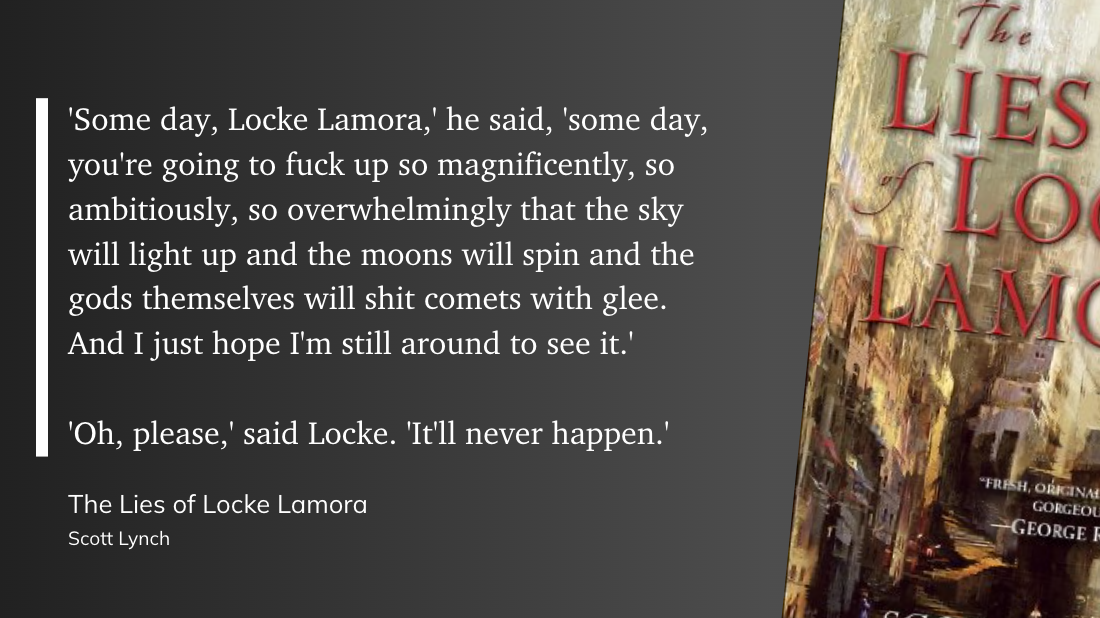
There is a moment early in The Lies of Locke Lamora where Father Chains — the blind priest who is not actually blind, and not actually a priest — explains to a young Locke Lamora exactly what kind of criminal he’s going to become. Not a common thief. Not a hired blade. Something more specific and considerably more dangerous: a con artist who targets the nobility of Camorr, the one category of victim that the city’s organized crime syndicate has quietly agreed to leave alone.
The Gentleman Bastards Secret. That’s what Lynch calls it. And the audacity of it — stealing from the most powerful people in a city run by criminals, hiding that fact from the criminals themselves — tells you everything you need to know about whether this book is for you. If that premise makes you grin, buckle in. If it makes you anxious about what happens when it inevitably unravels, also buckle in.
What It Is
The Lies of Locke Lamora is Scott Lynch’s 2006 debut novel, the first in the Gentleman Bastards series. It is set in Camorr, a fictional city that is essentially Renaissance Venice run by the mob — canals, ancient towers of alien glass left by a vanished civilization, a rigid criminal hierarchy, and enough filth and beauty coexisting in the same frame to make you feel like you’re actually there.
Locke Lamora is an orphan who becomes the most gifted con artist in Camorr. His crew, the Gentleman Bastards, pulls elaborate long cons against the city’s wealthy nobility — a category of victim so off-limits in the criminal underworld that nobody would think to look for thieves there. The book follows two timelines: the present day, where Locke is running his most ambitious scheme yet, and a series of interludes tracing his childhood and how he became who he is.
The comparison that keeps appearing in reviews is Ocean’s Eleven meets The Godfather. That’s accurate as far as it goes. I’d add: with the warmth of a found-family story underneath all the deception, and the gut-punch of grimdark fantasy when the plot decides to stop playing nice.
Why It Works
The thing everyone who loves this book mentions first is the voice. Lynch writes dialogue the way someone who genuinely enjoys language writes dialogue — it’s witty and foul-mouthed and character-specific in a way that feels earned rather than performed. The Gentleman Bastards bicker and insult each other constantly, and you understand their loyalty to each other precisely through the texture of how they argue. Nobody’s monologuing their feelings. Nobody needs to.
The dual-timeline structure is handled well. The interludes into Locke’s childhood do what flashbacks are supposed to do — they recontextualize what you’re reading in the present without dragging the plot sideways. By the time certain things happen in the present-day story, you’ve been prepared to feel them much more deeply than you would have if Lynch had told the story straight through.
Jean Tannen deserves particular mention. He is Locke’s best friend and the beating heart of the crew — a big, quiet, book-loving man who happens to be extraordinarily violent when the situation calls for it. The relationship between Locke and Jean is what gives the novel its emotional stakes. You root for the heists because they’re clever. You root for these characters because you genuinely care whether they survive.
The world-building is immersive without being oppressive. Lynch doesn’t stop the story to explain his world to you — he trusts the details to accumulate naturally, and they do. Camorr feels lived-in. The Elderglass towers feel genuinely strange. The criminal hierarchy feels as if it has a history that extends well before chapter one.
The Honest Part
The beginning is slow. This isn’t a controversial opinion — almost every review of this book, including the glowing ones, mentions it. The first fifty or so pages are dense with world-building and character setup, and the plot hasn’t found its footing yet. Lynch is laying track, not racing on it. If you trust the process, it pays off enormously. If you need momentum from page one, you might not get there.
The violence, when it comes, is not cartoonish. This is grimdark fantasy. People die suddenly and badly. Some of the deaths are genuinely brutal in a way that’s meant to be felt, not just processed as plot information. This is not a book that treats its violence as consequence-free, which I consider a feature. But it’s worth knowing going in.
There’s also the series situation, which I’d be dishonest not to mention: Lynch published The Lies of Locke Lamora in 2006, Red Seas Under Red Skies in 2007, and The Republic of Thieves in 2013. Book four has been in progress for over a decade with no confirmed publication date. If starting an unfinished series is a dealbreaker for you, that’s worth knowing. If, like me, you’ve long since made peace with the reality that some authors write slowly and the books that do exist are worth having, the first three are genuinely excellent.
The Verdict
This is one of the best fantasy debuts I’ve read. Lynch wrote a book that is simultaneously a heist thriller, a crime novel, a coming-of-age story, and a meditation on what friendship and loyalty actually mean when you’ve chosen a life built on deception. The pieces shouldn’t fit together as well as they do. They fit together perfectly.
The quote image I’ve kept from the original review captures the book’s energy better than most descriptions:
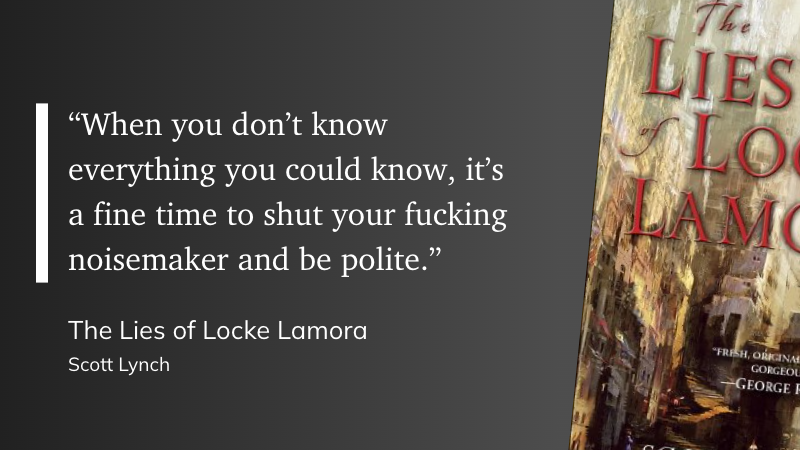
“When you don’t know everything you could know, it’s a fine time to shut your fucking noisemaker and be polite.”
— Scott Lynch, The Lies of Locke Lamora
That’s the book. Clever, profane, self-aware, and ultimately warmer than it has any right to be.
Rating: 4.5 out of 5 stars. (I bumped it up from my original 4 on reflection. The slow opening earned the half-star deduction; everything that follows earned it back.)
Get The Lies of Locke Lamora →
If You Liked This, Read Next
Red Seas Under Red Skies — The immediate sequel. Locke and Jean, new city, new con, new catastrophe. Different in tone (nautical heist rather than urban), equally entertaining.
The Republic of Thieves — Book three, and the one that finally explains the backstory of someone the first book only hints at. The most emotionally complex of the three published novels.
Six of Crows by Leigh Bardugo — The most common recommendation for readers who loved Locke Lamora. Morally grey crew, elaborate heist, excellent found-family dynamics. Younger in tone — less grimdark — but equally compelling.
The Name of the Wind by Patrick Rothfuss — Lynch and Rothfuss debuted within a year of each other and were constantly compared in the mid-2000s fantasy scene. Rothfuss is lyrical where Lynch is propulsive, but both center on a protagonist who is the most gifted person in the room and knows it. Also an unfinished series, alas.
The Blade Itself by Joe Abercrombie — If the grimdark edge of Locke Lamora is what hooked you — the sense that consequences are real and survival is not guaranteed — Abercrombie is the natural next stop. Darker, bleaker, absolutely brilliant.
Filed under: the pile of books recommended to me by multiple people who know my taste, and whose recommendations were entirely correct.
The Eclectic Educator is a free resource for everyone passionate about education and creativity. If you enjoy the content and want to support the newsletter, consider becoming a paid subscriber. Your support helps keep the insights and inspiration coming!