This post contains affiliate links. If you buy something through one of them, I earn a small commission at no extra cost to you. I only recommend things I’d actually use.
Updated April 2026
“When you stand inside somebody’s library, you get a powerful sense of who they are, and not just who they are now but who they’ve been… It’s a wonderful thing to have in a house.”
There’s something that happens when you walk into a room full of books that doesn’t happen anywhere else.
Don’t believe me? Go to your public library. Walk to the first stack you see and just stand there for a minute. Don’t browse. Don’t pull anything out. Just stand there and let it hit you.
That pull you feel — that sense that something in this room has something to say to you specifically — is real. And you can have it at home.
I started building my personal library seriously during the COVID-19 pandemic, when the world went quiet, and books became my primary companions. Three years later, my collection has grown into something that tells a story about who I was, who I am, and who I’m trying to become. Every shelf is a record of a season of life.
If you’ve ever wanted to build a personal library but didn’t know where to start — or if you have books scattered around your house in a state of benign chaos and want to bring some intention to them — this is your guide.
Why Build a Personal Library?
The most honest answer: because books deserve a home, not a pile.
But there’s more to it than organization. Nassim Nicholas Taleb has a provocative theory about this: “Read books are far less valuable than unread ones,” he writes in The Black Swan. “Your library should contain as much of what you do not know as your financial means allow. You will accumulate more knowledge and more books as you grow older, and the growing number of unread books on the shelves will look at you menacingly.”
He calls this an antilibrary — the idea that the books you haven’t read yet are the most important part of the collection, because they represent what you still don’t know.
I find this both humbling and motivating. My shelves are a constant reminder that the world is larger than what I’ve managed to read so far. That seems like exactly the right relationship to have with knowledge.
Beyond philosophy: a personal library is a tool for thinking. When you’re working through a problem — writing a dissertation, designing a curriculum, trying to understand a moment in history — having the right books physically accessible changes the quality of your thinking. You don’t have to remember where you read something; you just walk to the shelf.
Step One: Start With What You Already Have
The biggest mistake people make when deciding to build a personal library is thinking they need to start from scratch.
You probably have books already — scattered across rooms, stacked in corners, shoved into random shelves. Before you buy anything new, gather them. Pull them all into one place. Spread them out.
This exercise does two things. First, it shows you what you already have — including books you forgot you owned. Second, it shows you what kind of reader you are. The subjects that keep appearing, the authors you’ve collected multiple books from, the genres that dominate: that’s your intellectual fingerprint. It tells you what your library is already becoming.
From there, curating is mostly about intention. Each book you add should either deepen something you care about or open a door to something you don’t know yet.
Choosing Your Space
A personal library doesn’t require a dedicated room. It requires a dedicated intention.
If you have a spare room, great — you have the classic home library. If you don’t, here’s what actually works:
A single wall of shelving is enough to hold 200–400 books and to create a visual anchor that feels like a library, even in a living room. Floor-to-ceiling built-ins are the dream; adjustable freestanding shelves work perfectly well and can be rearranged as your collection grows.
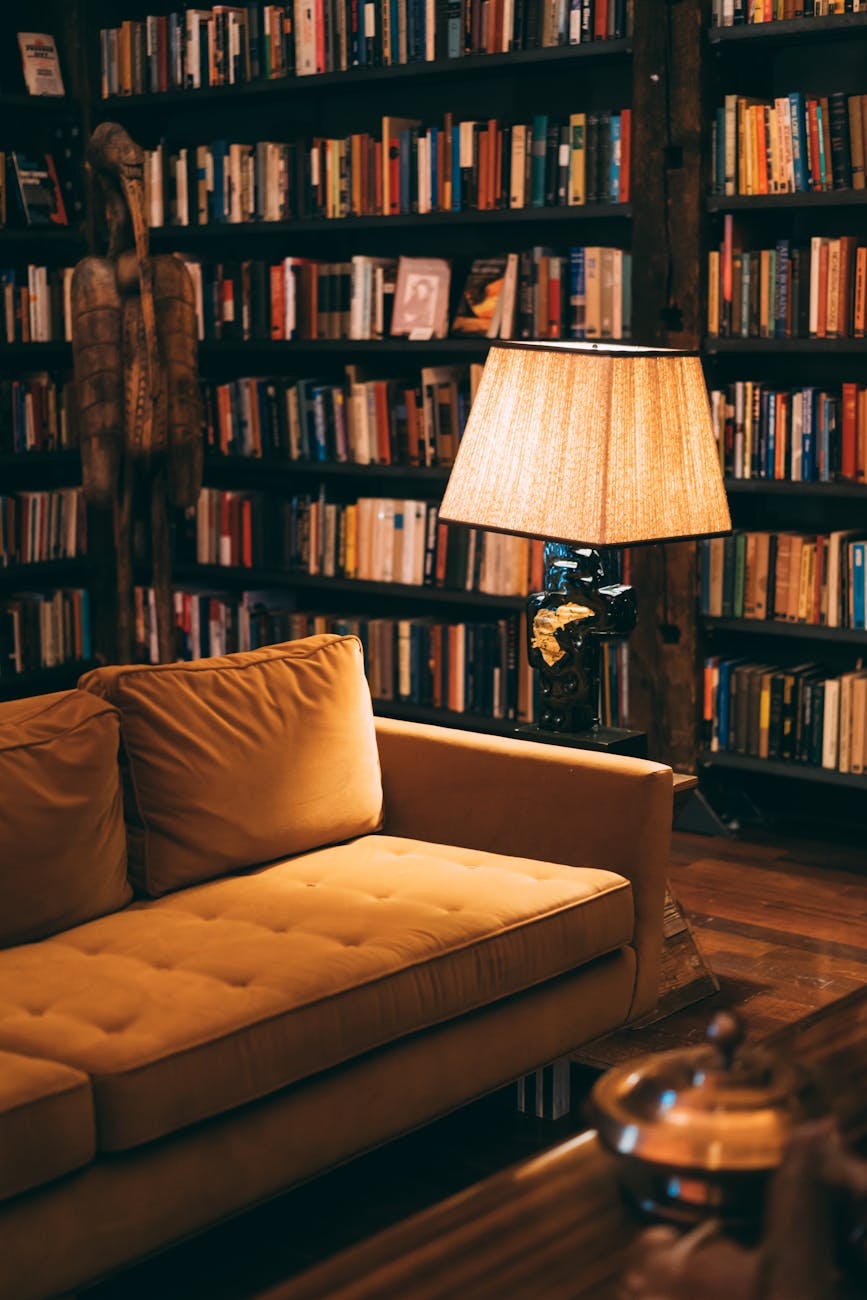
A dedicated corner with a comfortable reading chair and good lighting becomes a library for practical purposes. The physical definition of the space matters more than its size.
Books throughout the house are also a valid approach. Many serious readers have books in every room — fiction in the bedroom, non-fiction and reference in the office, kids’ books in the living room. The “library” is the whole house.
The key requirement, whatever the space is, is to keep it quiet, keep it well-lit, and make it somewhere you want to spend time.
The Tools That Make a Real Library
This is where most personal library guides fall short — they talk about books without talking about the physical tools that make a collection feel cared for and functional.
Bookshelves
The shelf is the foundation. Get something sturdy enough to hold the weight (books are heavy), adjustable enough to accommodate different sizes, and attractive enough that you want to look at it.
- Cube shelving — the standard for a reason. Modular, affordable, holds a lot.
- Adjustable wood bookcase with doors — better for protecting books from dust and light if you’re building a serious collection.
Bookends
You need these. Books left without support lean, warp, and damage their spines over time. A good pair of bookends is both functional and a small aesthetic statement.
Cast iron bookends are my preference — heavy enough to actually work, and they look like they belong in a library.
Bookplates and Date Stamps
This is one of my favorite parts of owning a physical library. Bookplates — small labels that go inside the front cover — are how you mark a book as permanently yours, the way institutional libraries have done for centuries. They’re inexpensive, and they make every book feel owned rather than acquired.
I use a date stamp to record when I add a book to the collection — an idea I shamelessly stole from Austin Kleon. There’s something satisfying about a record of when things arrived.
Bookplates are available in a dozen styles on Amazon — classic Ex Libris designs, modern minimalist, even customizable with your name.
Reading Accessories
A library is also a reading space. A few things that earn their place:
- A good reading light — clip-on LED lights for late-night reading without disturbing anyone.
- Page holder/book stand — for reading large reference books or keeping a book open while you take notes.
- Sticky flag tabs — my standard tool for marking passages while I read, so I can return to them without stopping to take notes.
- Blackwing pencils — for writing in the margins. Yes, I write in my books. It’s a thing, and it’s fine.
Organizing Your Personal Library
There is no wrong answer here. The only organizational system that matters is one you’ll actually maintain.
That said, here are the approaches worth considering:
By genre and subject — the most intuitive for most readers. Fiction in one section, history in another, science in another. Easy to find things, and browsing by section often leads to serendipitous rediscoveries.
Alphabetically by author — precise and unambiguous. Takes the guesswork out of finding anything specific. Works best once a collection is large enough that “roughly where it should be” is no longer good enough.
By reading status — unread, read, re-read. This is closer to Taleb’s antilibrary philosophy: keeping the unread books prominent reminds you of what’s still waiting.
By color — visually stunning, practically useless for finding anything. I don’t recommend this for a working library, but it photographs beautifully.
My own shelves use a hybrid: broad subject categories, with each alphabetized. It’s imperfect, and I’m fine with that.
Cataloging Your Collection
Once you have more than a few hundred books, a catalog becomes genuinely useful. The best tool for this is LibraryThing or Goodreads — both let you track what you own, what you’ve read, and what you want to read. LibraryThing has better collection management features; Goodreads has a larger community and better reading tracking.
Scan ISBN barcodes with your phone, and both apps will auto-populate title, author, and cover art. A collection of 500 books can be cataloged in a couple of evenings.
Where to Find Books
New books from independent bookstores — this is how I prefer to buy. Bookshop.org lets you shop online while supporting independent bookshops; worth knowing about as an alternative to Amazon when you’re buying books specifically.
Amazon — fast, reliable, often the best price on new releases. My Amazon Associates links throughout this post are the honest version of this recommendation.
ThriftBooks and AbeBooks — excellent for used books, out-of-print titles, and building a collection affordably. ThriftBooks, in particular, has very good condition grading and free shipping over a low threshold. Thriftbooks also has an educator program that gets you a free book for every five books you order – I use this too much…
Used bookstores and library sales — the treasure-hunting approach. You rarely find what you were looking for, but you almost always find something worth having. Library book sales are especially good for building deep collections in specific subjects at very low cost.
Estate sales and thrift stores — more misses than hits, but the hits can be remarkable. Old hardcovers in good condition for a dollar or two.
Creating the Right Atmosphere
The physical space matters. A collection of excellent books in a harsh, uncomfortable room is still an uncomfortable room.
Seating — you need somewhere to sit and read in or near your library. A good reading chair — something with arm support, comfortable back support, and the right height for reading — is worth the investment.
Lighting — a combination of ambient overhead light and a dedicated reading lamp. Warm light (2700–3000K color temperature) is easier on the eyes during long reading sessions than cool white light. LED floor lamps with adjustable color temperature work well.
Personal touches — artwork, plants, a small table for your coffee or tea, objects that mean something. This is your space. The books should be surrounded by other things you care about.
A Note on Digital Books
I read on my Kindle. I also own physical books of almost everything I’ve read on my Kindle that I thought was worth keeping.
These are not competing formats. They serve different purposes. The Kindle is for commuting, travel, and reading in the dark. Physical books are for reference, re-reading, and the library itself. If I read something on Kindle that earns a permanent place in my thinking, I buy the physical copy.
The Kindle Paperwhite remains the best e-reader for serious readers — good screen, long battery, excellent library integration. But it doesn’t replace the shelf.
FAQs
How many books do I need to start? No minimum. Fifteen books arranged with intention on a single shelf is a personal library. Start where you are.
How much does it cost? As much or as little as you want. A library built entirely from used books, thrift stores, and library sales costs almost nothing. A library of new hardcovers in dedicated built-in shelving costs quite a bit. Most real libraries land somewhere in between.
How do I maintain it? Dust occasionally. Keep books out of direct sunlight (UV fades spines and damages paper). Keep them away from high humidity. Don’t store them flat — books shelved warp horizontally over time. That’s really it.
Should I loan books out? I have opinions about this. Lend books you’re comfortable with the possibility of not getting back. For books that matter to you, buy a second copy specifically for lending. You’ll be happier.
What about books I’ve read and didn’t love? Donate them, give them away, sell them. A library should be curated, not comprehensive. The books that stay should be the ones you’d read again, recommend, or refer back to. The rest can go find a new reader.
The Last Word
Building a personal library is a long game. It takes years to assemble a collection that genuinely reflects who you are, and it should — because who you are keeps changing, and a good library should change with you.
Start small. Buy the books you love. Add the books you’re curious about. Make the space comfortable enough that you want to spend time in it.
The rest happens on its own.
My own collection lives and grows at the intersection of speculative fiction, history, education, and whatever I’m obsessing about this year. If you want to know what I’m reading, I share updates in my newsletter. And if you want to see the tools I use for reading and note-taking, they live on my Favorite Gear page.