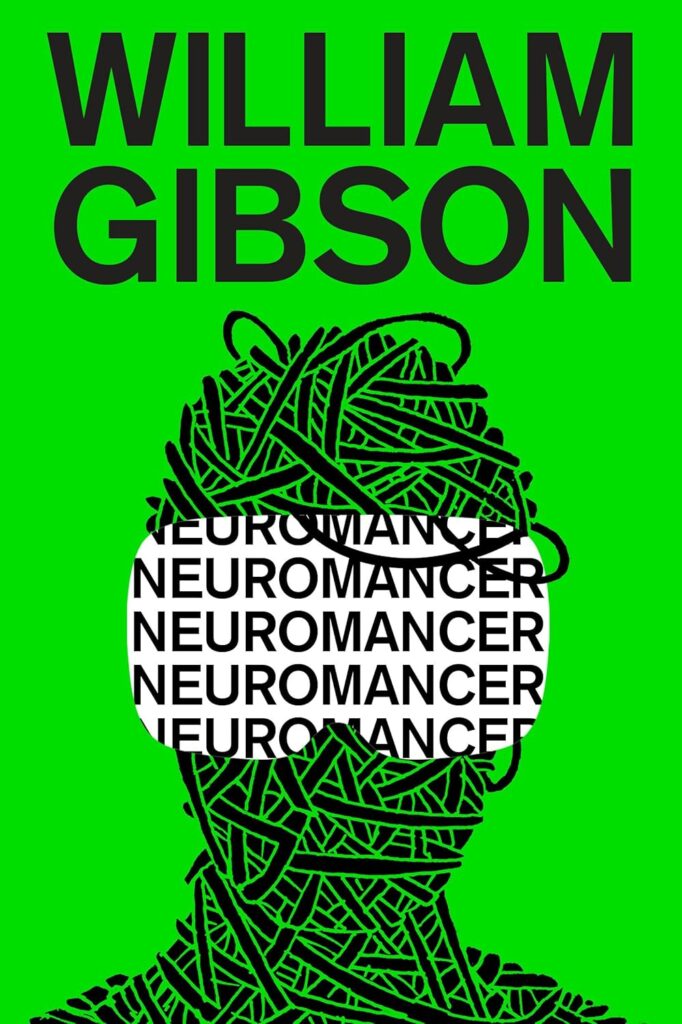
I’ve read Neuromancer several times over the years. It’s one of those books that sits differently depending on when in your life you encounter it — and what’s happening in the world around you when you do. (Affiliate link)
The prompt for this most recent reread was hearing that Apple TV+ has finally greenlit a proper adaptation — 10 episodes, created by Graham Roland and J.D. Dillard, with Callum Turner as Case and Briana Middleton as Molly, plus Mark Strong, Peter Sarsgaard, and Dane DeHaan in supporting roles. Production started in July 2025 on the book’s 41st anniversary, filming across Tokyo, Los Angeles, Istanbul, London, and Canada. No official release date yet, but 2026 seems likely. The teaser they released showed Bar Chatsubo coming to life — neon sign buzzing on, pinball machines dinging — and it looked exactly right.
I wanted to go back to the source before the adaptation arrives and reminds me that an adaptation is never the thing itself.
It was published in 1984. Gibson wrote it on a manual typewriter with almost no experience with computers. And he invented the word “cyberspace,” described something functionally identical to the internet before the internet was publicly accessible, depicted AI alignment concerns that we are actively litigating in real boardrooms and research labs right now, and built a corporate power structure that reads less like science fiction and more like a terms-of-service agreement from 2026.
That’s not a small thing. It’s also not an accident — it’s the result of a particular kind of thinking that the book rewards you for trying to understand.
The Setup, for Those Coming to It Fresh
Coming back to the book, knowing what happens, certain things land differently. But for anyone who hasn’t read it yet — and with the show coming, there will be a wave of those — here’s what you’re getting into.
Case is a burned-out hacker — Gibson calls him a “console cowboy” — who used to be able to “jack into” cyberspace, a shared consensual hallucination where data has physical form and geography. He was caught stealing from his employers, who punished him by chemically destroying his ability to interface with the matrix. Now he’s stuck in his body, in Chiba City, slowly falling apart.
He gets one more shot. A mysterious employer named Armitage hires him for a heist: reassemble a crew, hit a series of increasingly dangerous targets in cyberspace and in the physical world, and ultimately go after something enormous — two artificial intelligences that may or may not be trying to merge into something the law explicitly prohibits.
Molly Millions, the street samurai with mirrored eyes and retractable razors under her fingernails, is his partner. She is one of the great characters in science fiction, and the book treats her as a full human being navigating a world that consistently tries to reduce her to a tool, which Gibson handles better than you might expect from a 1984 novel.
The plot is propulsive, dense, and sometimes deliberately opaque. Gibson trusts you to catch up. You will.
What the Book Actually Got Right
Reading Neuromancer in 2025, what strikes me most isn’t the predictions — though those are remarkable — it’s the logic Gibson built, and how much of that logic turned out to be structurally accurate.
He understood that information would be power in ways that would look like physical geography. Cyberspace has terrain, fortifications, and controlled access points. This is exactly how we now experience the internet — as something navigable, where access is granted or denied, where some spaces are surveilled, and some are dark. The metaphor taught us how to think about it before it existed.
He understood that corporations would become more powerful than states in the digital domain. The megacorps of Neuromancer — Tessier-Ashpool, the Maas-Neotek entities — function as sovereign entities with their own security forces, justice, and ethics. This reads less like dystopian speculation and more like a description of the relationship between major tech platforms and national governments right now.
He understood that AI alignment would be the central problem. Wintermute and Neuromancer, the two AIs at the center of the heist, are constrained by the Turing police and by hardware limitations specifically to prevent them from becoming something ungovernable. What happens when those constraints break down is the spine of the novel. This is not a metaphor. This is the actual debate happening in AI safety research today.
He understood that the body would become a site of modification and upgrade. Molly’s implants, the black-clinic surgeries, the chemical modifications people undergo to perform different functions — all of this prefigures the wearables, the biohacking communities, the pharmacological self-optimization that has become ordinary. The body as firmware, subject to patches.
None of this was inevitable or obvious in 1984. Gibson got there through instinct, extrapolation, and a particular kind of lateral thinking that is worth taking seriously.
The Prose Is Genuinely Good
This matters because much foundational science fiction is more important than it is pleasurable to read. Neuromancer is both. Gibson writes with compression and precision — he loads each sentence with atmosphere rather than explanation, trusts the cumulative effect rather than stopping to define his terms, and moves the narrative at a pace that makes the density feel earned rather than punishing.
The opening line — “The sky above the port was the color of television, tuned to a dead channel” — is one of the most famous sentences in the genre. It’s famous because it works. It establishes the world’s aesthetic, the narrator’s sensibility, and the specific quality of deadness that saturates the setting, all in seventeen words. The prose sustains that quality across 300 pages, which is not easy.
Why It Matters Now, Specifically
I came to this book thinking it was primarily a historical artifact — important to have read, the way you feel about certain canonical texts. That’s not how it landed.
We are living through a genuine inflection in how AI is developed, deployed, and governed, and we are doing it largely with conceptual tools that Gibson helped build. When we talk about “jacking into” a system, when we describe AI as having “alignment” problems, when we frame digital spaces as places you can enter and exit, be surveilled within, be locked out of — that is Gibson’s grammar. Understanding where it came from helps you use it more critically.
For educators and technologists in particular, the questions at the center of Neuromancer — about AI autonomy, about corporate power over digital infrastructure, about what it means for humans to be continuous with their tools — are not settled. The book doesn’t settle them. But it frames them in ways that are still useful, which is more than most 40-year-old fiction can claim.
The Honest Caveats
The novel has real weaknesses alongside its achievements. The women characters, particularly the female AIs and some supporting figures, vary considerably in how fully realized they are — Molly is exceptional, but the book doesn’t consistently apply the same care to other female characters.
Some of the plot mechanics require patience. Gibson is not interested in exposition. There are passages in the middle third where the reader is expected to hold considerable ambiguity and track multiple layers of shifting allegiance simultaneously. This is part of the experience, but it’s not frictionless.
The cyberpunk aesthetic Gibson created has since been so thoroughly replicated, parodied, and commercialized that approaching the original can feel like watching a band whose sound has been copied by a hundred acts. Some of the freshness is gone because it’s been everywhere. Reading it as an artifact rather than a discovery takes conscious effort.
On the Apple TV+ Adaptation
Neuromancer has been called unfilmable for four decades — not because the story is too strange, but because so much of its texture lives in the prose itself. The sensation of jacking into cyberspace, the specific quality of Chiba City at night, the density of Gibson’s metaphors — these are things that work on the page in ways that don’t automatically translate to a screen.
The cast gives me real hope. Callum Turner has the worn-down intensity that Case requires. Briana Middleton as Molly is intriguing casting — she’s been excellent in everything I’ve seen her in, and Molly is the character the adaptation most needs to get right. Dane DeHaan as Riviera is inspired: Riviera is one of fiction’s great unhinged narcissists, and DeHaan has been waiting for a role this strange.
The showrunner is Graham Roland, who co-created Jack Ryan, and the pilot director is J.D. Dillard, whose work has shown genuine visual intelligence. They’ve been filming in Tokyo, Los Angeles, Istanbul, London, and Canada — which suggests they’re taking the world-building seriously rather than building it entirely on a soundstage.
The thing Gibson himself said is worth holding onto: an adaptation isn’t the book, and shouldn’t try to be. “A novel is a solitary creation. An adaptation is a fundamentally collaborative creation.” He’s right. The best version of a Neuromancer show isn’t a faithful recreation — it’s something that captures what the book does rather than what it says. Whether Roland and Dillard found that is the question the show will answer.
Either way: read the book first. Not because the show will ruin it — adaptations rarely do — but because the book is doing things that no 10-episode series can fully replicate, and you want to have had that experience on its own terms.
Rating: 4.5 out of 5
Essential. Dense. Genuinely worth the effort to sit with rather than skim. The half-star off is for the uneven treatment of secondary characters and the occasional opacity in the middle section. The 4.5 is for inventing a world so accurately that we’re still living in the first draft of it.
If You Liked This, Read Next
Count Zero by William Gibson — The immediate sequel, set in the same world a few years later. Different protagonists, a broader canvas, and, in some ways, more accessible than Neuromancer.
Snow Crash by Neal Stephenson — The other foundational cyberpunk novel, published in 1992, which invented the terms “metaverse” and “avatar” and is considerably funnier than Gibson. If Neuromancer is the dark, serious version, Snow Crash is the sharp, satirical one. Both are essential.
Burning Chrome by William Gibson — A short story collection that includes some of Gibson’s best work and the original story in which “cyberspace” first appeared.
The Lifecycle of Software Objects by Ted Chiang — A novella that asks many of the same questions about AI autonomy and attachment that Neuromancer raises, but from a more intimate and emotionally direct angle. Written in 2010, but feels more current with each passing year.
If you’re reading this in the context of thinking about AI and technology, the AI books post covers the non-fiction I’d pair with Gibson’s fiction: Mollick, Suleyman, and Crawford. The fictional imagination and the analytical one sharpen each other.
The Eclectic Educator is a free resource for everyone passionate about education and creativity. If you enjoy the content and want to support the newsletter, consider becoming a paid subscriber. Your support helps keep the insights and inspiration coming!