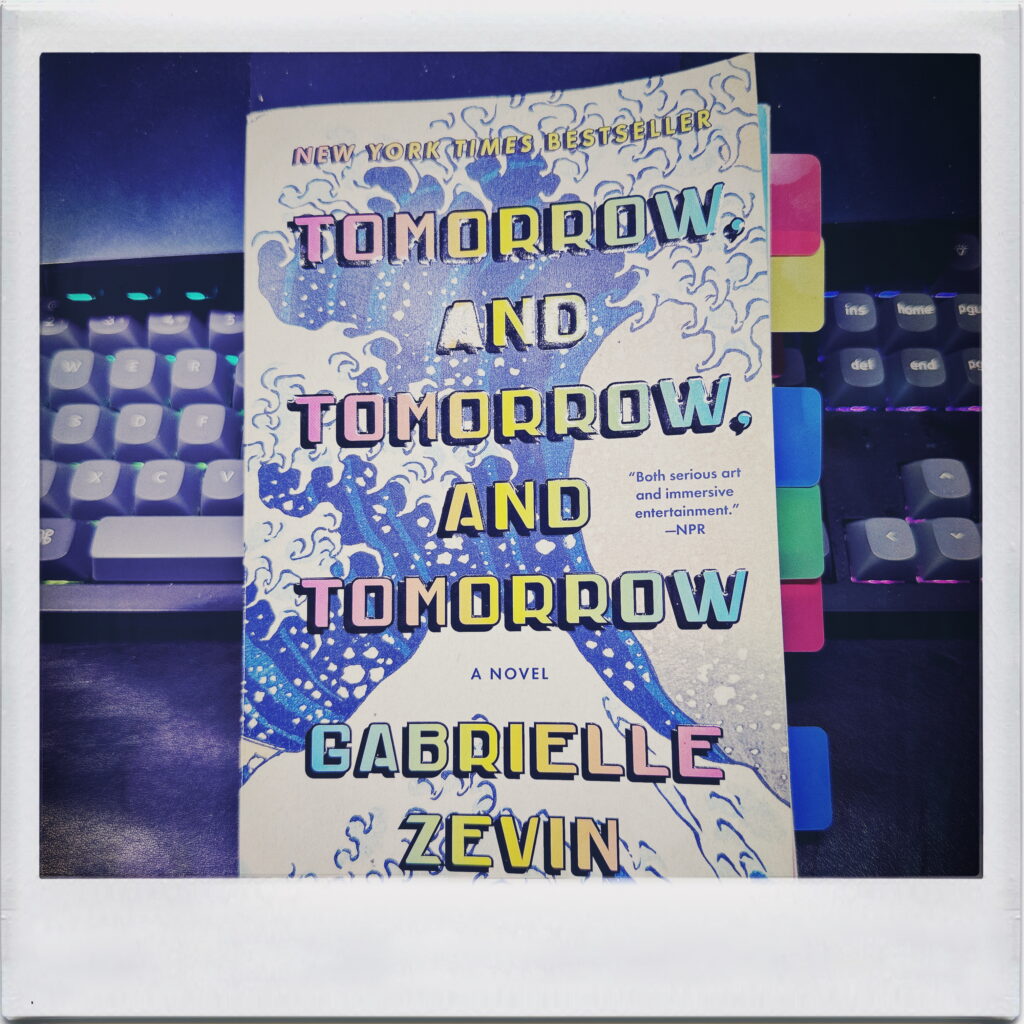
Book Review: Tomorrow, and Tomorrow, and Tomorrow by Gabrielle Zevin

book cover

I read this book over the summer, in that particular state of rest that July occasionally allows — the one that educators know well, when the school year is genuinely far enough away that you can read for pleasure without it feeling like time you should be spending on something else.

Tomorrow, and Tomorrow, and Tomorrow by Gabrielle Zevin sat on my TBR for a while because I was skeptical. A literary novel about video game designers. The hype was enormous. The overlap between “prestige literary fiction” and “video game culture” felt like it might produce something condescending to both.

It didn’t.


What It’s About

Sam Masur and Sadie Green first meet as children in a hospital, bonding over video games while Sam is recovering from a car accident that has shattered his foot. The friendship deepens, fractures, and then reforms years later when they encounter each other again in college — and discover they can make something together that neither could make alone.

The book spans thirty years and three coasts, following Sam and Sadie as they build a series of video games, a company, a complicated creative partnership, and a relationship that is one of the most fully realized portrayals of deep friendship I’ve read in recent fiction. Marx, Sam’s roommate who becomes their producer and eventually Sadie’s partner, is the third point of the triangle — generous, perceptive, and ultimately the character whose absence reshapes everything.

Zevin structures the novel partly around the games Sam and Sadie create, which mirror their emotional states and the health of their relationship. It’s a formal choice that shouldn’t work as well as it does. The games are real in the way fictional technology rarely feels real — specific, idiosyncratic, built with apparent care rather than gestured at.


The Macbeth Problem (or Gift)

The title comes from the “tomorrow, and tomorrow, and tomorrow” speech in Macbeth — one of the most despairing passages in Shakespeare. Macbeth, after his wife’s death, catalogs the emptiness of time, the way tomorrow keeps arriving and delivering nothing but more of the same meaninglessness.

Here’s Patrick Stewart’s take from a modern interpretation of Macbeth:

Zevin takes this and inverts it. The “tomorrows” in her novel are not nihilistic. They are the respawns — the new game, the fresh start, the decision to keep playing after failure. The book is in conversation with the speech in a way that isn’t heavy-handed: the reference illuminates without dominating.

For educators, and I’m thinking here specifically about what it means to start a new school year, this inversion lands differently than it might for other readers. Every August is a tomorrow in exactly Zevin’s sense. Not the Macbeth sense — not emptiness recycling — but the choice to come back to something you believe in, again, after whatever last year held. That’s not a small thing to name.


What the Book Gets Right

Zevin is excellent on the texture of creative partnership — the way collaboration requires vulnerability, the way credit becomes a site of injury, the way people who make things together can genuinely love each other and also genuinely damage each other through the work. The professional and the personal don’t separate cleanly in Sam and Sadie’s relationship, and Zevin doesn’t pretend they should.

The treatment of disability is careful and specific. Sam’s foot injury — which eventually leads to amputation — is present throughout the book not as a symbol but as a lived reality that shapes his movement, his endurance, his relationship to physical space and physical pain. It’s not the defining fact of his character, but it’s not invisible either.

The friendship itself, which Zevin consistently describes as love without romance, is the novel’s real subject and greatest achievement. Sam and Sadie are “often in love, but never lovers” — and Zevin makes that distinction feel earned rather than coy. The question the book refuses to answer is whether their relationship would have been better or worse if it had become romantic, and the refusal feels honest rather than evasive.


What Doesn’t Quite Land

The novel is long and sometimes diffuse. Zevin covers thirty years of characters’ lives across multiple coasts and collaborations, and the middle section loses momentum in ways the beginning and end don’t. Some readers will find this immersive; others will find it baggy.

Some of the secondary characters — particularly the antagonists — function more as plot machinery than people. The novel’s sympathies are clearly with Sam and Sadie, and the characters who create obstacles for them occasionally feel as though they exist solely for that purpose rather than as full human beings.

The tech industry milieu is well-rendered but could have pushed harder on the structural inequities of creative industries. Sadie’s experience as a woman in gaming is addressed but somewhat lightly — a few scenes of credit being stolen, a few moments of being underestimated — in ways that feel like acknowledgment rather than full engagement.


Why I Kept Thinking About It

The reason this book stayed with me into August and into the start of the school year is the question at its center: what does it mean to keep making things together, across setbacks, failures, and the wreckage of what didn’t work?

The games Sam and Sadie build aren’t perfect. Some are failures. Some succeed in ways that create new problems. The process is recursive, sometimes painful, and never finished. And they keep doing it because the alternative — not making anything, not collaborating, not returning to the relationship even when it’s been damaged — is worse.

That’s not a bad frame for teaching. Or for any work that asks you to keep showing up to something that matters, in partnership with other people, over the years.

Rating: 4.5 out of 5 stars.

Get Tomorrow, and Tomorrow, and Tomorrow


If You Liked This, Read Next

A Little Life by Hanya Yanagihara — The other major literary novel of the last decade about a decades-spanning friendship between creative people. Significantly darker and more harrowing than Zevin’s novel. If you can handle it, it’s extraordinary.

The Midnight Library by Matt Haig — The most direct overlap on the “what if you could respawn, what lives might you have lived” question. Lighter than Zevin, more explicitly hopeful, and a genuinely affecting read.

Piranesi by Susanna Clarke — Another novel about navigating an invented world with its own strange rules, and what it means to find meaning and connection inside a reality that isn’t quite the ordinary one. Very different in tone from Zevin, but shares something with the game-as-parallel-world structure.

Klara and the Sun by Kazuo Ishiguro — A novel about observation, loyalty, and the limits of understanding the people you care most about. Quieter than Zevin but similarly interested in the question of what we owe to the people we love.


I also wrote a newsletter piece that blends this book with Shakespeare’s Macbeth and Jane McGonigal’s Reality is Broken, reflecting on what the “respawn” metaphor means for educators heading into a new school year. Read it here →


The Eclectic Educator is a free resource for everyone passionate about education and creativity. If you enjoy the content and want to support the newsletter, consider becoming a paid subscriber. Your support helps keep the insights and inspiration coming!


Four Thousand Weeks Book Review & Summary for Teachers (2025): Oliver Burkeman’s Time-Management Blueprint to Beat Burnout and Reclaim Classroom Time

confused businessman checking time on wristwatch
Photo by Andrea Piacquadio on Pexels.com

When the average human lifespan is broken into weeks, it comes out to roughly 4,000 tiny squares on a calendar. Oliver Burkeman’s Four Thousand Weeks: Time Management for Mortals argues that every choice you—or your teachers—make is an irrevocable investment of one of those squares. That simple, urgent idea is the antidote to the chronic overload driving record-high teacher stress and attrition. Below is the straight-talk pitch I deliver when I hand the book to a classroom teacher—no fables, no fluff, just a direct-response case for why this needs to be the first professional-development read of the new school year.


The Pain You Already Feel

  • Teachers are working an average of 49 hours per week—ten more than they’re paid for—and still feel behind. (RAND Corporation)
  • Seventy-eight percent have considered quitting since the pandemic. (National Education Association)
  • Three-quarters now shoulder extra duties to cover shortages, compounding burnout. (Devlin Peck)
  • A typical classroom loses the equivalent of ten instructional days each year to interruptions alone. (Education Week)

Those numbers aren’t a motivation problem; they’re a math problem. No planner, rubric, or inbox-zero ritual will create the hours you don’t have. Burkeman starts where every other productivity guru won’t: by admitting you can’t fit it all in.


The Big Idea Teachers Haven’t Tried Yet

Burkeman’s thesis is deceptively simple: because you’re finite, you must decide—up front—what you will not do. Reviewers have called the book “refreshingly alternative” to hustle culture (Matt Swain) and “a wise meditation on human transience” (Janice Greenwood). For educators drowning in initiatives, it’s a life-raft made of three core moves:

  1. Choose what to fail at. Instead of trying to “balance” everything, deliberately neglect low-stakes tasks so high-impact work can thrive (Finding Mastery).
  2. Work from a “closed” list. Keep a limitless “open” list for every possible to-do, but restrict your active list to ten items—nothing enters until something exits (Reddit).
  3. Pay yourself first with time. Devote your best hour each day to priorities that matter before the building’s demands siphon your focus (sidsavara.com).

These are not trendy hacks. They are structural shifts that acknowledge the conveyor-belt reality of modern schools.


Five Transformations Your Teachers Will See

1. From Endless Prep to Deliberate Impact

Adopting the closed-list rule forces teachers to ask: Which planning task will move student learning the farthest today? Every “yes” becomes a promise to finish, not a vague ambition. In trials outside education, practitioners report sharper focus and lower anxiety after just one week (idratherbewriting.com).

2. From Reactive to Strategic Inbox

Burkeman’s “decide what to fail at” legitimizes delayed email responses. When leaders institute 24-hour reply windows, RAND found teacher stress indicators drop while retention rises (RAND Corporation). Guiltless triage frees hours that would otherwise be lost to back-and-forth threads.

3. From Exhausted Evenings to Guarded Mornings

The “pay yourself first” principle mirrors personal-finance wisdom: invest before you spend. Guardian productivity analysts list tackling the hardest task first as one of the top ways to regain calendar control (The Guardian). Teachers who block the first prep period for deep work finish grading faster and carry less home.

4. From Hustle Guilt to Intentional Leisure

Burkeman reframes rest as an end, not a recharge tactic—critical, given that female educators report higher burnout than their peers every year since 2021 (RAND Corporation). Structured downtime protects cognitive bandwidth for tomorrow’s classes.

5. From Initiative Fatigue to Focused Mastery

When districts subtract old programs before adding new ones, they see stronger morale and fewer resignations (idratherbewriting.com). The book supplies the philosophical permission slip administrators need to prune the agenda.


What Your Teachers Will Learn—Chapter by Chapter

ChapterTeacher Translation
The Limit-Embracing LifeWhy the dream of “someday I’ll catch up” is a trap—and how to stop waiting for it.
The Efficiency TrapProof that faster grading often creates more grading (looking at you, instant-feedback apps).
The Watermelon ProblemHow to spot “busywork masquerading as importance” before it hijacks planning time.
The Cluttered Desk of the MindMental techniques to resist the dopamine pull of hallway interruptions and push notifications.
The End of Time ManagementA practical blueprint for the closed-list system and serial focus—complete with classroom-ready examples.

Each chapter concludes with thought experiments and micro-habits that are easy to test during a single prep block.


Hard Proof It Works

  • Technical writer David Kowalsky reduced his active task list from 27 items to 7 in one week by adopting the open/closed system (idratherbewriting.com).
  • Readers on Goodreads consistently cite the “closed list” as the most transformational takeaway (Goodreads).
  • Productivity forums report that the two-list method can slash context-switching fatigue within days (Reddit).

If it can tame an entrepreneur’s workload, it can tame a teacher’s.


How to Roll It Out Next Week

  1. Assign Chapters 1-3 for a PLC discussion. Frame it around the RAND burnout data to root the conversation in urgency (RAND Corporation).
  2. Pilot the closed-list in one content team. Compare instructional-minute recovery against the EdWeek interruption baseline of ten lost days (Education Week).
  3. Use the “choose what to fail” exercise to cut one legacy assignment per unit. Frees cognitive load for feedback that matters.
  4. Protect a daily “pay yourself first” slot; even 15 minutes meets Guardian guidelines for reclaiming focus (The Guardian).
  5. Revisit results after two weeks. Expect fewer late-night grading marathons and clearer student feedback cycles.

Objections You’ll Hear—and How to Answer

“I can’t ignore emails—parents will panic!”
Set automated replies promising a 24-hour turnaround. Research shows that delayed, thoughtful answers can reduce the need for follow-up emails, ultimately netting you more goodwill (The Guardian).

“My to-do list won’t fit on one page.”
That’s the point. The overflow belongs on the open list where it can’t ambush your attention (Goodreads).

“I don’t have time to read a book.”
Burkeman’s 288 pages equal four 40-minute commutes or one Netflix mini-series. The ROI is reclaiming weeks this semester.


Ready to Start?

Grab the Book on Amazon →

Your teachers don’t need another app, spreadsheet, or motivational poster. They need a paradigm that acknowledges reality, honors their limited weeks, and channels focus where it counts: student learning. Four Thousand Weeks delivers exactly that.


Sources

  1. Matt Swain, book summary of Four Thousand Weeks (Matt Swain)
  2. RAND Corporation, State of the American Teacher 2025 (RAND Corporation)
  3. NEA, “What’s Causing Teacher Burnout?” (National Education Association)
  4. Devlin Peck, Teacher Burnout Statistics 2025 (Devlin Peck)
  5. Education Week, Classroom Interruptions Study (Education Week)
  6. Janice Greenwood, book review of Four Thousand Weeks (Janice Greenwood)
  7. Guardian, 14 Productivity Hacks (The Guardian)
  8. Reddit r/Productivity, “4000 Weeks To-Do List” (Reddit)
  9. David Kowalsky, productivity experiments (idratherbewriting.com)
  10. Goodreads quote on open/closed lists (Goodreads)
  11. Jessica Mehring, “Choosing What You Fail At” (Jessica Mehring, Author)
  12. Oliver Burkeman interview on Finding Mastery (Finding Mastery)

The 40-Hour Teacher Week Myth (and 7 Time-Saving Tools That Actually Work)

black and white photo of clocks
Photo by Andrey Grushnikov on Pexels.com

The Lie We’ve All Been Sold

If you’re a teacher, you know the truth: 40 hours is a fantasy.

Between planning, grading, answering emails, parent meetings, PD sessions, hallway duty, IEPs, MTSS meetings, and trying to breathe for a moment, teaching is a job that routinely demands 50 to 60 hours per week, and sometimes even more. It’s not that we’re bad at time management. It’s that we’re swimming against a system that wasn’t designed for sustainability.

But here’s the good news: while you may not be able to control the system, you can change how you manage your time within it.

In this post, we’re going to:

  • Debunk the 40-hour teacher week
  • Explore how to design your time like a limited resource
  • Share 7 time-saving tools that can actually help you win back your evenings and weekends
  • Provide practical, teacher-tested time hacks you can implement right away

Let’s dig in.

Why the 40-Hour Week Doesn’t Exist in Education

The idea of a 40-hour workweek originated from industrial labor models—you clock in, you do your job, and you clock out. But teaching isn’t just a job. It’s a calling, a performance, a planning-intensive, people-heavy, paperwork-dense act of organized chaos.

Here’s how time actually gets spent:

  • Instruction: 30+ hours/week
  • Lesson planning & prep: 5–10 hours/week
  • Grading and feedback: 5–8 hours/week
  • Emails and communication: 3+ hours/week
  • Meetings (PLC, IEP, PD, admin): 2–5 hours/week

And that’s before you factor in classroom setup, tech troubleshooting, data analysis, sub plans, hallway coverage, behavior documentation, and the emotional labor of being “on” all day.

Teaching is a job that will expand to consume every available minute if you let it.

That’s why reclaiming your time starts with a mindset shift.


Time Budgeting vs. Task Management

Traditional time management says, “Make a list and get it all done.”

But that assumes time is infinite and predictable. It’s not.

Instead, use a time budgeting mindset: you start with a finite amount of time and allocate it intentionally.

Try this:

  • Budget 30 minutes to plan tomorrow’s lesson. When the timer goes off, stop. Done is better than perfect.
  • Give yourself 45 minutes to grade a set of quizzes. Use a single-point rubric or comment bank to speed it up.
  • Block off 1 hour for parent communication. Use templated responses, voice memos, or batch them in your planning period.

You wouldn’t overspend your money without consequence. Don’t overspend your time.


The 80% Rule: Done Is Better Than Perfect

Aim for 80%.

We waste enormous energy trying to make things perfect—the perfect slide deck, the perfect anchor chart, the perfect assignment. And while excellence matters, so does survivability.

Let go of perfection and embrace “effective enough.”


7 Time-Saving Tools Every Teacher Should Use

Each of these is designed to save time without sacrificing quality—and yes, they’re all tools I either use or would recommend.


1. Planbook.com – Digital Lesson Planning Made Simple

Say goodbye to clunky binders and endless Google Docs. Planbook allows you to plan, align to standards, and adjust with drag-and-drop ease.
Affiliate Tip: Mention the ability to copy lessons year-to-year, saving hours in future terms.


2. Google Keep – Fast Notes, Checklists, and To-Dos

Think of it as your sticky note board, digitized. Keep is great for batching feedback notes, tracking student conferences, and setting reminders.
Pro Tip: Use labels like “Grading,” “Parent Calls,” or “Copy Room” to stay organized.


3. ClickUp or Notion – Project Management for Educators

Use these to manage units, track standards, or even collaborate across your PLC.
Want to build a weekly to-do board? Create a reusable template.


4. Grammarly Premium – Write Faster, Grade Smarter

Speed up parent emails, student feedback, and even lesson materials. Let Grammarly handle grammar, tone, and conciseness so you can focus on content.


5. Mote – Voice Comments in Google Classroom

Record personalized audio feedback directly into student work. Students engage more, and you save time typing.
It’s also fantastic for English learners and students with IEP accommodations.


6. Text Blaze – Auto-Responses and Comment Banks

If you find yourself typing the exact phrases over and over, Text Blaze lets you create keyboard shortcuts that expand into full sentences, feedback, or email replies.
Think: /grade1 = “Great start! Please expand on your second point.”


7. Rocketbook – Reusable Smart Notebook

Want to plan on paper but keep it digital? Write in this notebook, scan it with your phone, and send it directly to Google Drive, Notion, or email.
Great for capturing notes from PD or coaching conversations, then tossing them into your digital workflow.

5 Time-Saving Habits to Build This Month

Tools help. But systems sustain. Here are habits to pair with your tools:

1. Theme Your Days

  • Monday: Lesson planning
  • Tuesday: Grading
  • Wednesday: Family communication
  • Thursday: Data and meetings
  • Friday: Catch up + self-care

2. Use Comment Banks and Rubrics

Create a Google Doc with your most-used feedback phrases. Pair with single-point rubrics in Google Classroom.

3. Batch Like a Boss

Group similar tasks (e.g., grade all assignments from 2nd period, then all from 3rd) to reduce cognitive switching.

4. Automate What You Can

Schedule recurring parent newsletters. Use auto-responders during peak grading periods. Build email templates.

5. Reflect Weekly

Take 15 minutes each Friday to reflect:

  • What worked?
  • What drained me?
  • What can I tweak for next week?

Final Thoughts: Time Is a Teacher’s Most Precious Resource

You are not a robot. You are not lazy. You are not doing it wrong.

You are working inside a system that asks too much and gives too little.

But with the right tools and some intentional design, you can reclaim your time.

You deserve to leave school without guilt. You deserve a weekend. You deserve a full life.

And it starts by treating your time as sacred.