I read this book over the summer, in that particular state of rest that July occasionally allows — the one that educators know well, when the school year is genuinely far enough away that you can read for pleasure without it feeling like time you should be spending on something else.
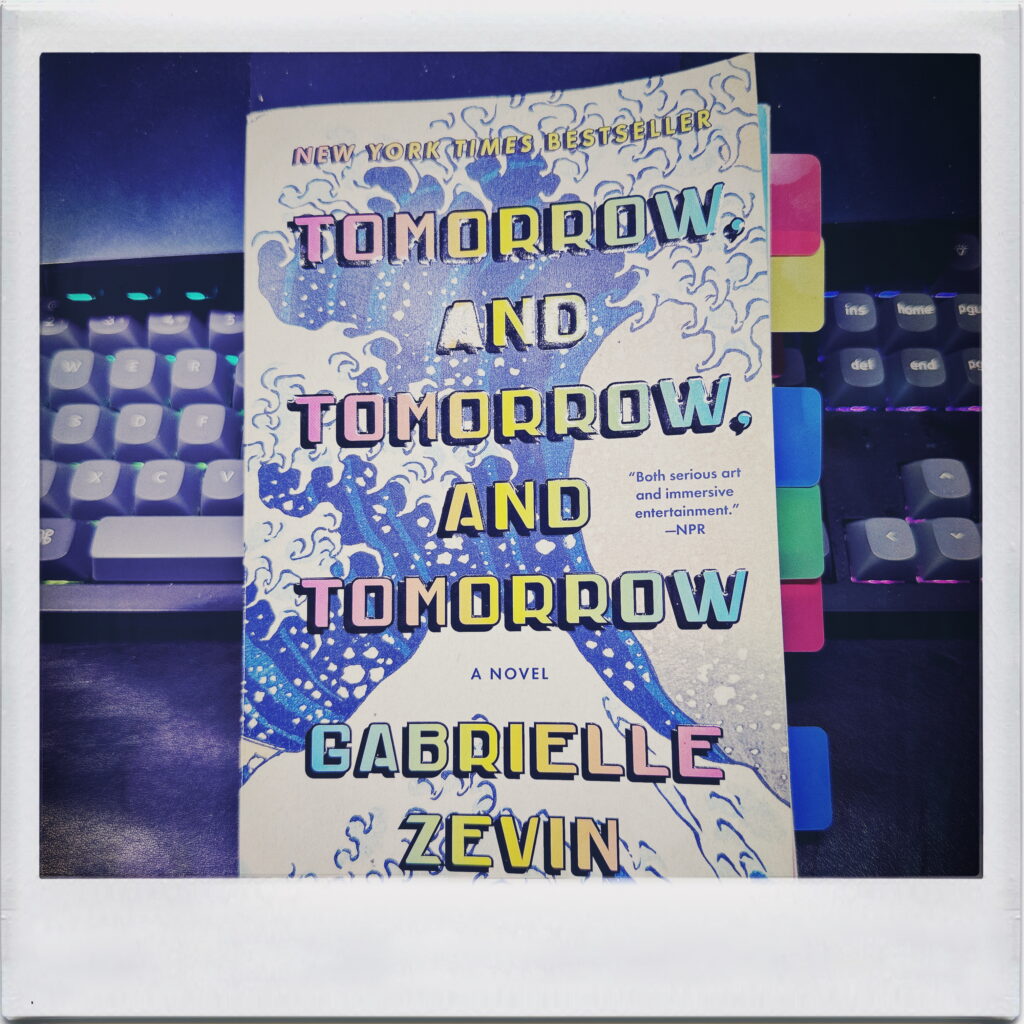
Tomorrow, and Tomorrow, and Tomorrow by Gabrielle Zevin sat on my TBR for a while because I was skeptical. A literary novel about video game designers. The hype was enormous. The overlap between “prestige literary fiction” and “video game culture” felt like it might produce something condescending to both.
It didn’t.
What It’s About
Sam Masur and Sadie Green first meet as children in a hospital, bonding over video games while Sam is recovering from a car accident that has shattered his foot. The friendship deepens, fractures, and then reforms years later when they encounter each other again in college — and discover they can make something together that neither could make alone.
The book spans thirty years and three coasts, following Sam and Sadie as they build a series of video games, a company, a complicated creative partnership, and a relationship that is one of the most fully realized portrayals of deep friendship I’ve read in recent fiction. Marx, Sam’s roommate who becomes their producer and eventually Sadie’s partner, is the third point of the triangle — generous, perceptive, and ultimately the character whose absence reshapes everything.
Zevin structures the novel partly around the games Sam and Sadie create, which mirror their emotional states and the health of their relationship. It’s a formal choice that shouldn’t work as well as it does. The games are real in the way fictional technology rarely feels real — specific, idiosyncratic, built with apparent care rather than gestured at.
The Macbeth Problem (or Gift)
The title comes from the “tomorrow, and tomorrow, and tomorrow” speech in Macbeth — one of the most despairing passages in Shakespeare. Macbeth, after his wife’s death, catalogs the emptiness of time, the way tomorrow keeps arriving and delivering nothing but more of the same meaninglessness.
Here’s Patrick Stewart’s take from a modern interpretation of Macbeth:
Zevin takes this and inverts it. The “tomorrows” in her novel are not nihilistic. They are the respawns — the new game, the fresh start, the decision to keep playing after failure. The book is in conversation with the speech in a way that isn’t heavy-handed: the reference illuminates without dominating.
For educators, and I’m thinking here specifically about what it means to start a new school year, this inversion lands differently than it might for other readers. Every August is a tomorrow in exactly Zevin’s sense. Not the Macbeth sense — not emptiness recycling — but the choice to come back to something you believe in, again, after whatever last year held. That’s not a small thing to name.
What the Book Gets Right
Zevin is excellent on the texture of creative partnership — the way collaboration requires vulnerability, the way credit becomes a site of injury, the way people who make things together can genuinely love each other and also genuinely damage each other through the work. The professional and the personal don’t separate cleanly in Sam and Sadie’s relationship, and Zevin doesn’t pretend they should.
The treatment of disability is careful and specific. Sam’s foot injury — which eventually leads to amputation — is present throughout the book not as a symbol but as a lived reality that shapes his movement, his endurance, his relationship to physical space and physical pain. It’s not the defining fact of his character, but it’s not invisible either.
The friendship itself, which Zevin consistently describes as love without romance, is the novel’s real subject and greatest achievement. Sam and Sadie are “often in love, but never lovers” — and Zevin makes that distinction feel earned rather than coy. The question the book refuses to answer is whether their relationship would have been better or worse if it had become romantic, and the refusal feels honest rather than evasive.
What Doesn’t Quite Land
The novel is long and sometimes diffuse. Zevin covers thirty years of characters’ lives across multiple coasts and collaborations, and the middle section loses momentum in ways the beginning and end don’t. Some readers will find this immersive; others will find it baggy.
Some of the secondary characters — particularly the antagonists — function more as plot machinery than people. The novel’s sympathies are clearly with Sam and Sadie, and the characters who create obstacles for them occasionally feel as though they exist solely for that purpose rather than as full human beings.
The tech industry milieu is well-rendered but could have pushed harder on the structural inequities of creative industries. Sadie’s experience as a woman in gaming is addressed but somewhat lightly — a few scenes of credit being stolen, a few moments of being underestimated — in ways that feel like acknowledgment rather than full engagement.
Why I Kept Thinking About It
The reason this book stayed with me into August and into the start of the school year is the question at its center: what does it mean to keep making things together, across setbacks, failures, and the wreckage of what didn’t work?
The games Sam and Sadie build aren’t perfect. Some are failures. Some succeed in ways that create new problems. The process is recursive, sometimes painful, and never finished. And they keep doing it because the alternative — not making anything, not collaborating, not returning to the relationship even when it’s been damaged — is worse.
That’s not a bad frame for teaching. Or for any work that asks you to keep showing up to something that matters, in partnership with other people, over the years.
Rating: 4.5 out of 5 stars.
Get Tomorrow, and Tomorrow, and Tomorrow
If You Liked This, Read Next
A Little Life by Hanya Yanagihara — The other major literary novel of the last decade about a decades-spanning friendship between creative people. Significantly darker and more harrowing than Zevin’s novel. If you can handle it, it’s extraordinary.
The Midnight Library by Matt Haig — The most direct overlap on the “what if you could respawn, what lives might you have lived” question. Lighter than Zevin, more explicitly hopeful, and a genuinely affecting read.
Piranesi by Susanna Clarke — Another novel about navigating an invented world with its own strange rules, and what it means to find meaning and connection inside a reality that isn’t quite the ordinary one. Very different in tone from Zevin, but shares something with the game-as-parallel-world structure.
Klara and the Sun by Kazuo Ishiguro — A novel about observation, loyalty, and the limits of understanding the people you care most about. Quieter than Zevin but similarly interested in the question of what we owe to the people we love.
I also wrote a newsletter piece that blends this book with Shakespeare’s Macbeth and Jane McGonigal’s Reality is Broken, reflecting on what the “respawn” metaphor means for educators heading into a new school year. Read it here →
The Eclectic Educator is a free resource for everyone passionate about education and creativity. If you enjoy the content and want to support the newsletter, consider becoming a paid subscriber. Your support helps keep the insights and inspiration coming!