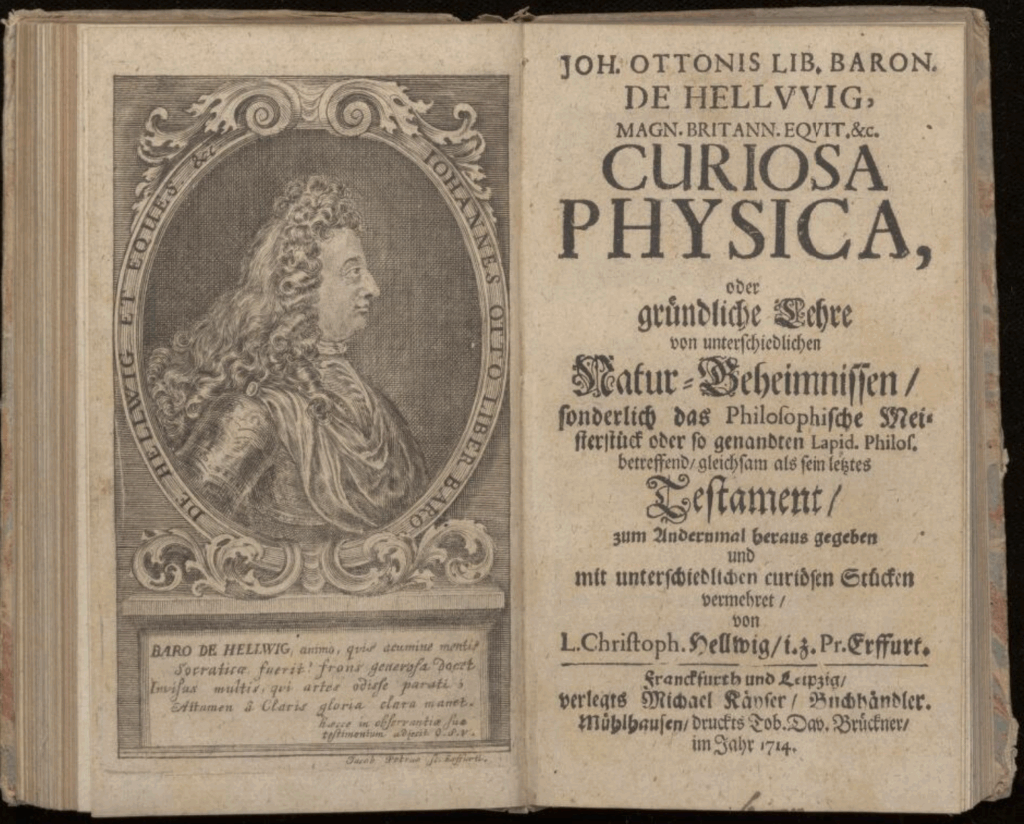
I want to tell you about a library in Amsterdam housed in a 17th-century building called the House with the Heads, funded in part by the author of The Da Vinci Code, with a collection that was granted UNESCO Memory of the World status in 2022, and whose digital archive you can browse for free from your couch right now.
The Bibliotheca Philosophica Hermetica — the Ritman Library, now housed at the Embassy of the Free Mind — contains roughly 30,000 titles on Western esotericism, mysticism, alchemy, astrology, Kabbalah, Rosicrucianism, and related traditions. In 2018, after Dan Brown donated €300,000 to fund the digitization project (he’d visited the library multiple times while researching The Lost Symbol and Inferno), the library launched what they called, with genuine wit, Hermetically Open: a free, publicly accessible digital archive of its rarest pre-1900 texts. As of 2025, 2,178 books are fully scanned and available online.
The collection includes the Corpus Hermeticum from 1472, Giordano Bruno’s work from 1584, the first printed visual representation of the Kabbalistic Tree of Life from 1516, alchemical manuscripts with intricate hand-drawn diagrams, and hundreds of texts in Latin, Dutch, German, French, and English that blur every boundary we’ve drawn between science, philosophy, theology, medicine, and magic.
My first thought when I found this collection was: this is exactly what I want students to encounter.
Why “Occult” Is the Wrong Frame for This
The word does its work on us. “Occult” conjures Halloween aesthetics and conspiracy theories, and it’s easy to dismiss the whole thing as fringe material with no serious application in a classroom.
That reaction, though, says more about our current assumptions about knowledge than it says about these texts.
For several centuries of Western intellectual history, there was no clean dividing line between alchemy and chemistry, between astrology and astronomy, between hermetic philosophy and natural science. Isaac Newton — who gave us calculus, the laws of motion, and the theory of universal gravitation — spent at least as much of his intellectual energy on alchemy and Biblical prophecy as he did on physics. His alchemical manuscripts are available online too, through Cambridge’s digital library. The man who arguably launched the scientific revolution was also, by any contemporary definition, deeply engaged in occult practice.
This isn’t an embarrassing footnote. It’s actually essential context for understanding how scientific knowledge develops — through the messy, often wrong, often ideologically entangled process of humans trying to make sense of the world with the conceptual tools they have available. The Ritman collection is a primary source archive for that story.
As a doctoral student who has spent years reading about how knowledge is constructed, organized, and transmitted, I find this collection genuinely thrilling. These books are where the medieval and the modern collide. They’re where you can see what people got wrong and what they got surprisingly right, often in the same text, often for reasons that have nothing to do with intelligence and everything to do with the conceptual frameworks available to them.
That’s exactly what I want students to sit with.
What Makes This Useful for Teachers
The collection isn’t neat. It’s multilingual, dense, and built for scholars. That’s part of the point — it’s not pre-digested curriculum content, it’s actual historical material that requires work to interpret. For teachers who believe students should wrestle with primary sources rather than always receiving polished summaries of them, this is a goldmine.
A few ways I’d use this across disciplines:
History and Social Studies — Trace how alchemy became chemistry. Look at how astrology shaped political decisions in early modern Europe. Ask students why the intellectual tradition represented here was systematically excluded from what we now call the history of science, and what that exclusion says about how we decide what counts as legitimate knowledge.
English and Literature — The visual and linguistic strangeness of these texts is remarkable. The archaic spellings, the “long s” that looks like an f, the allegorical imagery, the blend of Latin and vernacular — all of it offers material for close reading and for connecting to the Gothic, Romantic, and magical realist traditions that drew heavily from this well.
Science — Contrast alchemical “recipes” with modern chemical procedures. Examine how flawed models of the cosmos were still generative — the people using them weren’t stupid, they were working at the edge of what was knowable. What does that say about our own current models?
Art and Design — The illuminated manuscripts and alchemical diagrams in this collection are extraordinary visual objects. The symbolic language is dense and codified and genuinely beautiful. There’s serious material here for design history, visual communication, and semiotics.
Philosophy — The Hermetic tradition represents a sustained attempt to synthesize Greek philosophy, early Christian theology, Jewish mysticism, and natural observation into a unified account of reality. That synthesis didn’t work out the way its practitioners hoped. But the attempt itself raises questions about knowledge, interpretation, and the limits of any single framework for understanding the world — questions that don’t go away.
The cross-disciplinary angle is what I find most powerful. One of the things that frustrated me most in my years as an educator before moving into instructional coaching is how thoroughly we’ve siloed knowledge. Students take chemistry, history, and English as separate things, as if the history of chemistry weren’t fascinating, as if the literary history of science didn’t exist. The Ritman collection doesn’t respect those boundaries because it predates our drawing of them.
The Resource
The collection is free, fully accessible online, and searchable — though the search interface takes some patience. The direct link to the digital catalog is here. I’d recommend starting with the “Digital collection” page, which gives you some orientation before you dive in.
A few things worth knowing:
- The majority of texts are in Latin, Dutch, German, or French. English-language texts exist, but aren’t the majority. For classroom use, this is actually an opportunity — translation, context-building, and working with unfamiliar material are valuable skills.
- The image quality varies, but the rare and fragile items were prioritized for digitization, so many of the most valuable texts are well scanned.
- The broader collection, which includes 30,000 titles and continues to grow, is housed at the Embassy of the Free Mind in Amsterdam. If you’re ever there, it’s worth visiting.
The collection earned UNESCO Memory of the World status in 2022, a designation UNESCO does not hand out lightly. This is genuinely important cultural heritage, now freely available to anyone with internet access. That’s remarkable.
Dan Brown’s novels that led him to the Ritman Library — The Lost Symbol and Inferno — both draw heavily on the kind of Hermetic and esoteric tradition documented in this collection. If you want a somewhat lurid but surprisingly well-researched tour of the ideas, they’re a decent starting point. Brown is not a subtle writer, but he did his homework.
Related on this site: the AI books post covers how knowledge evolves and what it means to think critically about the tools we use — a thread that runs directly through what this collection makes visible.