Here’s the thing nobody in education wants to say out loud: a significant portion of what we call “teaching” is actually just teachers doing the work that students should be doing.
Teachers write the summaries. Teachers generate the discussion questions. Teachers create the study materials. Teachers provide all the feedback. Teachers design all the reflection prompts. And then we wonder why students are passive, why engagement is low, and why teachers are burning out at alarming rates.
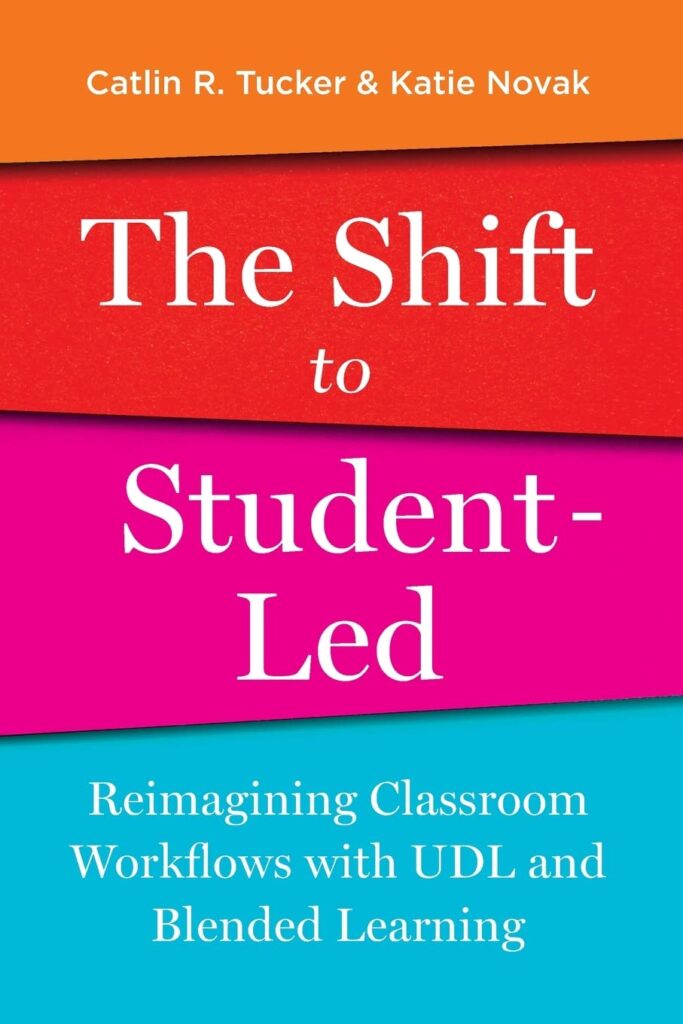
The Shift to Student-Led: Reimagining Classroom Workflows with UDL and Blended Learning by Catlin Tucker and Katie Novak is a direct response to this problem. As an instructional coach, I find myself recommending this book regularly — not because it’s revelatory, but because it articulates something that’s very hard to put into words in a 50-minute faculty meeting and then hands you tools to actually do something about it.
What the Book Is Actually About
Tucker and Novak are explicit about their starting point: they’ve worked with too many exhausted teachers. The context is post-pandemic education, where teachers who were already stretched thin absorbed years of additional uncertainty, disruption, and grief — and are now expected to simply resume as if none of that happened. The book isn’t optimistic about the status quo. It explicitly states that the current model isn’t sustainable and makes a structural argument for why.
The structural argument is this: when teachers are the primary workers in a classroom — the ones generating content, facilitating discussion, providing feedback, assessing progress — they create passive learners and exhausted professionals. The labor is distributed entirely wrong. Students are spectators in their own education, and teachers do a job that can’t be done by one person for 30 students without someone getting shortchanged. Usually, someone is the teacher.
The solution Tucker and Novak offer is to redistribute that labor through what they call student-led workflows — specific, structured shifts that move each of those teacher-dominated tasks back to students. Ten shifts in total, one per chapter, each paired with Universal Design for Learning (UDL) principles and blended learning strategies that make the shift manageable across a diverse classroom.
UDL and Blended Learning — Why These Two
The combination isn’t arbitrary. UDL addresses the persistent challenge of designing learning for the full range of students in a classroom without creating 30 different lesson plans. Its core principle — build flexibility and choice into the design from the start rather than retrofitting accommodations afterward — directly enables student agency. When multiple means of engagement, representation, and expression are built in, students can direct more of their learning because the options are available.
Blended learning addresses the logistics. Technology, when used intentionally, creates the structures that enable student-led workflows at scale. Not technology as a substitute for teaching, but technology as the infrastructure that lets students access content, track their own progress, collaborate asynchronously, and document their thinking in ways that a purely analog classroom can’t sustain.
Neither of these ideas is new. What Tucker and Novak do is show specifically how they work together to shift who does the work, which is a more practical frame than either concept provides on its own.
The Ten Shifts
The book’s ten workflows move through five areas: lessons, assessments, practice, feedback, and discussions. In each area, Tucker and Novak show what the teacher-led version looks like, what problems it creates, what the research suggests, and what a student-led version looks like with concrete examples and implementation tools.
A few that land particularly well in the coaching conversations I have:
From teacher-provided feedback to student self-assessment. This is the shift most teachers resist hardest, and most students need most. The book makes a compelling case that waiting for teacher feedback creates learned helplessness — students who can’t evaluate their own work are dependent on external validation in ways that don’t serve them in college, career, or life. The practical tools for building student capacity to assess their own work are among the most immediately usable in the book.
From teacher-led discussion to student-facilitated conversation. Whole-class discussions in which the teacher asks questions and students respond are a remarkably inefficient way to build thinking. Tucker and Novak offer structures — including protocols that can run entirely without teacher direction — that shift the facilitation to students. This one requires patience to implement; students who have been in teacher-led discussions their whole lives don’t immediately know how to facilitate for each other. But the payoff is substantial.
From teacher-created practice to peer-generated learning resources. When students create flashcards, summaries, or quiz questions for each other, they’re doing the cognitive work that actually builds retention. The teacher’s job shifts from resource creator to quality reviewer, which is a genuinely different and more sustainable role.
What It Gets Right
The book earns its positive reputation with practitioners primarily because it doesn’t just describe what student-led learning looks like — it walks through the implementation with enough specificity to actually try it. The templates and protocols are real, the scenarios are recognizable, and Tucker and Novak are honest that these shifts take time and that students will push back initially because passive learning is more comfortable in the short term.
The framing of teacher sustainability is also well handled. This isn’t positioned as “here’s how to do more for students” — it’s positioned as “here’s how to stop doing work that isn’t yours to do,” which is a meaningfully different message for a profession that has normalized unsustainable self-sacrifice.
What to Watch For
A couple of honest caveats from the coaching side of this.
The book is designed primarily for secondary and post-secondary classrooms, though the principles extend further. Elementary teachers will find more adaptation required.
As with most professional development books, the gap between reading the ideas and actually implementing them in the classroom is real. The templates help, but student-led workflows require significant upfront investment in building the routines and student capacity that make them work. The book is clear about this, but it’s easy to underestimate when reading.
And the blended learning components assume a level of access to technology and reliability that isn’t universal. The ideas hold without the technology, but the specific digital strategies require some translation for under-resourced classrooms.
Who Should Read This
Teachers who feel like they’re carrying their classrooms on their backs — this book is written directly for you, and the framing will be immediately recognizable.
Instructional coaches supporting teachers in designing more student-centered practice — I’d use this as a book study anchor and the companion resources as coaching tools.
School leaders thinking about what sustainable teaching practice actually looks like — the structural argument in the opening chapters is worth your time, even if you don’t go chapter by chapter through the workflows.
Free resources from the authors:
- Templates for choice boards, self-assessments, and project planning
- Book club discussion guide for PLCs
Related on this site: the free play and Peter Gray post makes a parallel argument about who does the work of learning — and what happens to kids when adults take over tasks that should belong to them.