
25 Essential Books Recommended by Marc Andreessen for Entrepreneurs, Leaders, and Thinkers

marc andreessen

Marc Andreessen, the co-founder of Netscape and renowned venture capitalist, has revolutionized the tech industry and inspired countless minds with his reading recommendations. His favorite books span psychology, entrepreneurship, philosophy, and history, offering profound insights for anyone seeking to grow personally and professionally. Here’s a curated selection of the most notable books Andreessen has endorsed:

Psychology & Personal Development Books

Thinking, Fast and Slow by Daniel Kahneman

Daniel Kahneman, a Nobel Prize-winning psychologist, explores the two systems that drive our thinking: the fast, intuitive, and emotional system (System 1) and the slower, deliberate, and logical system (System 2). Kahneman explains how these systems interact to shape our judgments, decisions, and behaviors, often leading to biases and errors. By understanding the dynamics of these systems, readers can become more aware of their cognitive blind spots and learn strategies to mitigate their influence. The book is an essential guide for anyone seeking to make better decisions, whether in business, personal life, or public policy.

Kahneman’s writing is rich with engaging anecdotes and real-world applications, making complex psychological concepts accessible to a broad audience. He covers topics like heuristics, prospect theory, and the psychology of risk, all of which have profound implications for fields as diverse as marketing, leadership, and finance. Thinking, Fast and Slow is more than a book; it’s a framework for understanding how we think and how we can think better.

12 Rules for Life by Jordan Peterson

Jordan Peterson’s “12 Rules for Life” guides navigating the chaos of modern life with order, discipline, and purpose. Drawing from psychology, philosophy, and mythology, Peterson offers practical advice on topics like taking responsibility for your actions, setting meaningful goals, and maintaining healthy relationships. Each rule is illustrated with engaging stories and deep insights into human behavior.

Peterson’s writing is profound and accessible, appealing to readers across generations and backgrounds. He emphasizes the importance of individual agency and the pursuit of meaning, making this book a powerful tool for personal growth. Whether seeking to overcome challenges, build a fulfilling life, or better understand yourself and others, 12 Rules for Life provides timeless principles.

The Courage to Be Disliked by Ichiro Kishimi

Inspired by Alfred Adler’s teachings, Ichiro Kishimi’s The Courage to Be Disliked introduces readers to personal freedom and empowerment philosophy. The book is structured as a dialogue between a philosopher and a young man, exploring themes like self-acceptance, interpersonal relationships, and the courage to forge one’s path. At its core, the book encourages readers to let go of societal expectations and focus on creating a life aligned with their values.

The conversational format makes complex psychological concepts easy to grasp and apply. Kishimi’s exploration of Adlerian psychology challenges traditional views of happiness and success, offering a refreshing perspective on living authentically. This book is a must-read for anyone looking to break free from limiting beliefs and embrace a life of purpose and courage.

Can’t Hurt Me by David Goggins

David Goggins’ memoir, “Can’t Hurt Me,” is a raw and inspiring account of his journey from hardship to becoming one of the toughest individuals on the planet. Goggins shares his struggles with poverty, racism, and self-doubt and how he overcame them through sheer determination and mental toughness. His philosophy of embracing discomfort and pushing past limits resonates deeply with readers seeking to unlock their potential.

The book combines autobiographical elements with actionable advice, challenging readers to adopt a “can’t hurt me” mindset. Goggins introduces concepts like the “40% rule,” which suggests that we are capable of much more than we think. This book is a rallying cry for resilience and self-discipline, offering a roadmap for turning adversity into achievement.

Behave by Robert M. Sapolsky

Behave by Robert M. Sapolsky is a masterful exploration of human behavior, offering a multidisciplinary approach to understanding why we do what we do. Sapolsky examines the biological, psychological, and social factors that influence behavior, starting with the milliseconds before action and working backward to evolutionary history. His analysis covers aggression, morality, and empathy, revealing the complex interplay of genes, environment, and culture.

Sapolsky’s writing is engaging and often humorous, making even the most intricate scientific concepts accessible. The book has insights that challenge conventional wisdom and deepen our understanding of human nature. Behave is a must-read for anyone curious about the roots of behavior and the factors that shape our decisions, emotions, and relationships.

A Guide to the Good Life by William B. Irvine

In “A Guide to the Good Life,” William B. Irvine reintroduces readers to Stoic philosophy, offering practical advice for living with tranquility and purpose. The book translates ancient wisdom into actionable modern life strategies, focusing on controlling desires, overcoming adversity, and finding contentment. Irvine’s pragmatic approach emphasizes how Stoicism can help individuals navigate challenges and lead more fulfilling lives.

What sets this book apart is its accessibility. Irvine avoids academic jargon, making Stoicism relatable and applicable to everyday situations. Whether seeking to cultivate resilience, manage stress, or find more profound meaning, A Guide to the Good Life provides timeless tools for personal growth and happiness.


Entrepreneurship & Leadership

Zero to One by Peter Thiel

Peter Thiel, co-founder of PayPal and a leading venture capitalist, challenges conventional thinking about startups and innovation in Zero to One. His central argument is that creating truly transformative businesses requires moving from “zero to one,” building something new rather than simply iterating on existing ideas. Thiel delves into the principles of monopoly formation, the importance of contrarian thinking, and the need for founders to cultivate unique visions for the future.

The book is both a practical guide and a philosophical manifesto. Thiel draws on his experiences in Silicon Valley to offer actionable advice on everything from product development to company culture. For aspiring entrepreneurs, “Zero to One” is a roadmap to navigating the complexities of innovation in a way that creates lasting value. Thiel’s insights into competition and differentiation make this book a must-read for anyone aiming to leave a significant mark in their field.

The Hard Thing About Hard Things by Ben Horowitz

In this candid and often humorous book, Ben Horowitz, co-founder of Andreessen Horowitz, shares hard-earned lessons from his experiences as a startup CEO. Unlike many business books focusing on success stories, Horowitz dives into the messy business realities—layoffs, tough decisions, and the constant uncertainty that defines leadership. His advice is grounded in real-world challenges, making the book relatable and practical for entrepreneurs at all stages.

Horowitz’s writing style is engaging, with rap lyrics and anecdotes that bring his points to life. He emphasizes the importance of resilience, decision-making, and leadership in navigating the “hard things” that don’t have easy answers. Whether you’re building a startup or managing a team, this book offers a wealth of insights to help you tackle the inevitable growth and innovation challenges.

High Output Management by Andrew Grove

Andrew Grove, the legendary former CEO of Intel, delivers a timeless guide to practical management in High Output Management. The book breaks down the complexities of leading teams and organizations into actionable principles, focusing on measurable outcomes. Grove introduces concepts like the managerial leverage model, task prioritization, and the importance of structured meetings. His emphasis on efficiency and output makes this a must-read for anyone in a leadership role.

This book’s combination of practical advice and strategic insight sets this book apart. Grove’s background in technology and manufacturing informs his understanding of systems thinking and operational excellence, making his lessons universally applicable across industries. Whether managing a small team or a global enterprise, High Output Management equips you with tools to maximize productivity and drive results.

The Lean Startup by Eric Ries

Eric Ries revolutionized the startup world with his concept of “lean” methodology, which emphasizes rapid experimentation, customer feedback, and iterative development. In “The Lean Startup,” Ries outlines a systematic approach to building and scaling businesses in an environment of extreme uncertainty. By adopting practices like the Build-Measure-Learn loop and Minimum Viable Product (MVP), entrepreneurs can reduce risk and increase their chances of success.

The book contains case studies and real-world examples illustrating how lean principles have been applied across industries. Ries also highlights the cultural and organizational shifts needed to embrace continuous learning and adaptability. For anyone looking to launch or grow a business, The Lean Startup offers a clear and actionable framework for navigating the challenges of entrepreneurship in a rapidly changing world.

Extreme Ownership by Jocko Willink

In Extreme Ownership, former Navy SEAL Jocko Willink shares hard-hitting leadership lessons learned on the battlefield. The book emphasizes that leaders must take full responsibility for their team’s success or failure, regardless of the circumstances. By adopting this mindset, individuals can build trust, improve performance, and create a culture of accountability.

Willink’s military experiences add a compelling layer to his leadership insights, making the book both gripping and practical. Each chapter pairs a battlefield story with a business or personal application, demonstrating how the principles of extreme ownership can be applied in any context. Whether leading a team, managing a project, or striving for personal growth, this book offers actionable strategies to elevate your leadership skills.

Play Nice But Win by Michael Dell

Michael Dell’s memoir, Play Nice But Win, chronicles his journey from starting Dell Technologies in his dorm room to building one of the world’s most successful technology companies. The book highlights the values of innovation, perseverance, and collaboration, offering an insider’s look at the triumphs and challenges of leading a global enterprise. Dell’s mantra of “play nice but win” reflects his belief in achieving success without compromising integrity.

The memoir also delves into Dell’s pivotal decision to take his company private and return it to the public markets. Through candid anecdotes and business insights, Dell provides valuable lessons for entrepreneurs and leaders navigating complex environments. This book is an inspiring story and a practical guide to building and sustaining a successful business.


Philosophy, History & Big Ideas

Poor Charlie’s Almanack by Charlie Munger

Poor Charlie’s Almanack offers a deep dive into the mind of Charlie Munger, Warren Buffett’s longtime business partner and one of the greatest investors ever. The book compiles Munger’s speeches, essays, and insights, blending practical advice with wisdom from various disciplines. Central to Munger’s philosophy is the concept of “worldly wisdom,” the idea that success comes from integrating knowledge across multiple domains, including psychology, economics, and history.

Richly illustrated and filled with humor, Poor Charlie’s Almanack is not just an investment manual but a guide to living a thoughtful and principled life. Munger’s focus on mental models—conceptual frameworks for understanding the world—has influenced countless leaders and thinkers. This book is an invaluable resource for anyone seeking to make better decisions, solve complex problems, and build a life of integrity and impact.

The Rational Optimist by Matt Ridley

In The Rational Optimist, Matt Ridley presents a compelling case for why humanity’s best days are still ahead. Ridley explores how innovation, trade, and human ingenuity have driven progress throughout history, arguing that the same forces will continue to solve global challenges like poverty, climate change, and resource scarcity. His optimism is grounded in data, making the book hopeful and evidence-based.

Ridley’s narrative is engaging, with historical examples illustrating human collaboration’s transformative power. By focusing on solutions rather than problems, the book offers a refreshing perspective on the future. “The Rational Optimist” is an inspiring read for those who believe in the potential of human creativity to address even the most daunting challenges.

The Rise of Superman by Steven Kotler

Steven Kotler explores the science of peak performance in “The Rise of Superman,” focusing on “flow”—a state of complete immersion and heightened focus. Using extreme sports as a lens, Kotler examines how athletes achieve extraordinary feats by tapping into flow and how the same principles can be applied in other fields. The book combines neuroscience, psychology, and compelling stories to uncover the keys to unlocking human potential.

Kotler’s writing is thrilling and informative, making complex scientific ideas accessible to readers. By understanding the triggers and benefits of flow, individuals can improve performance, creativity, and well-being. “The Rise of Superman” is an inspiring read for anyone looking to push their boundaries and achieve more personally or professionally.

The WEIRDest People in the World by Joseph Henrich

Joseph Henrich’s The WEIRDest People in the World examines how Western, Educated, Industrialized, Rich, and Democratic (WEIRD) societies became so culturally distinct. Henrich argues that cultural evolution, rather than genetics, is the primary driver of these differences, with a focus on the role of religion, institutions, and historical events. The book traces the origins of WEIRD psychology, highlighting how changes in family structures and social norms have shaped everything from individualism to scientific thinking.

Henrich’s interdisciplinary approach, combining anthropology, psychology, and history, makes this book a tour de force in understanding cultural diversity. By exploring the unintended consequences of historical shifts, Henrich provides valuable insights into why WEIRD societies think and behave as they do. This book is essential for anyone seeking to understand the cultural forces that have shaped modernity.

Public Choice Theory and the Illusion of Grand Strategy by Richard Hanania

In Public Choice Theory and the Illusion of Grand Strategy, Richard Hanania critiques traditional interpretations of U.S. foreign policy, arguing that it is driven more by domestic political incentives than by cohesive, strategic planning. Drawing on public choice theory, Hanania reveals how bureaucratic interests, voter preferences, and political pressures shape policy decisions in ways that often defy logic or long-term goals.

The book provides a fresh perspective on international relations, challenging readers to rethink assumptions about government decision-making. Hanania’s insights are relevant for political scientists and anyone interested in understanding the complexities of governance. His clear and engaging writing makes this a compelling read for academics and general audiences.

The True Believer by Eric Hoffer

Eric Hoffer’s classic, The True Believer, examines the psychology of mass movements and the individuals who drive them. Hoffer explores why people join movements, what sustains them, and how they evolve. His insights are as relevant today as they were when the book was first published, shedding light on worldwide political, social, and religious movements.

The book is philosophical and practical, offering a nuanced understanding of human behavior and group dynamics. Hoffer’s writing is concise yet profound, making it accessible to readers of all backgrounds. “The True Believer” is a must-read for anyone seeking to understand the forces that shape societies and the motivations behind collective action.

The End of History and the Last Man by Francis Fukuyama

Francis Fukuyama’s The End of History and the Last Man is a landmark work in political philosophy that examines the evolution of governance and society. Fukuyama argues that liberal democracy represents the culmination of humanity’s ideological evolution, suggesting that history as a contest of competing ideologies has effectively ended. He explores the implications of this “end of history,” including its potential to create complacency and undermine human striving.

The book is provocative and deeply analytical, drawing on many historical, philosophical, and cultural references. Fukuyama’s thesis has sparked extensive debate, making it a cornerstone of modern political thought. Whether you agree with his conclusions or not, “The End of History and the Last Man” challenges readers to reflect on the trajectory of human progress and the future of democracy.


Tech & Innovation

Only the Paranoid Survive by Andrew Grove

Andrew Grove, the legendary CEO of Intel, shares his philosophy for navigating strategic inflection points in Only the Paranoid Survive. A strategic inflection point is when a company faces transformative change—from market shifts, technological advancements, or competitive pressures. Grove provides a framework for identifying and responding to these critical moments, emphasizing that survival and success require vigilance and adaptability.

The book is a masterclass in strategic thinking, offering insights for businesses and personal growth. Grove’s emphasis on paranoia as a tool for staying ahead of change challenges traditional leadership paradigms. By sharing real-world examples from Intel and beyond, he underscores the importance of embracing change as an opportunity rather than a threat, making this book a vital read for anyone seeking to thrive in an ever-evolving world.

Who Is Michael Ovitz? by Michael Ovitz

Who Is Michael Ovitz? is the candid memoir of one of Hollywood’s most influential power brokers. Michael Ovitz, co-founder of Creative Artists Agency (CAA), recounts his rise to prominence, revolutionary approach to talent representation, and role in shaping modern Hollywood. The book provides an insider’s perspective on the entertainment industry, filled with anecdotes about iconic celebrities, high-stakes deals, and Ovitz’s relentless drive for success.

Beyond the glitz and glamour, Ovitz reflects on his challenges, including his controversial departure from CAA and subsequent ventures. His story is about ambition, innovation, and resilience, offering lessons for leaders in any field. “Who Is Michael Ovitz?” is an entertaining memoir and a masterclass in navigating power and influence.

Conspiracy by Ryan Holiday

In Conspiracy, Ryan Holiday delves into the true story of how billionaire Peter Thiel orchestrated the takedown of Gawker Media, sparking a debate on power, privacy, and the limits of revenge. The book chronicles the events leading to Gawker’s bankruptcy, including Thiel’s secret funding of Hulk Hogan’s lawsuit. Holiday explores this covert campaign’s motivations, ethical dilemmas, and ripple effects, presenting it as a case study of the complexities of influence and ambition.

Holiday’s narrative is gripping, blending investigative journalism with philosophical inquiry. He challenges readers to consider the fine line between justice and vengeance and what happens when individuals wield outsized power in pursuit of personal agendas. “Conspiracy” is a thought-provoking read that offers insights into media, ethics, and the dark undercurrents of human behavior.

The Network State by Balaji Srinivasan

Balaji Srinivasan’s “The Network State” envisions a future where technology and decentralized networks transform governance and societal organization. Srinivasan argues that traditional nation-states are becoming obsolete, and network states—communities built on shared values and blockchain technology—offer a viable alternative. The book blends futurism with practical ideas, exploring how these digital-first societies could redefine citizenship, governance, and community.

Srinivasan’s ideas are bold and provocative, pushing readers to rethink their assumptions about the future. “The Network State” is a must-read for anyone interested in the intersection of technology, society, and governance, offering a roadmap for a decentralized and innovative future.

Economics in One Lesson by Henry Hazlitt

Henry Hazlitt’s “Economics in One Lesson” is a classic introduction to economic principles, written for a general audience. Hazlitt simplifies complex concepts, focusing on the idea that good economics considers policies’ short-term and long-term effects on all groups. His lessons challenge popular misconceptions and emphasize the importance of individual freedom and market dynamics.

The book’s clarity and timeless relevance make it a foundational text for anyone interested in economics. Hazlitt’s ability to distill complex ideas into accessible insights has inspired generations of readers, making “Economics in One Lesson” a must-read for students, policymakers, and curious minds alike.

Who We Are and How We Got Here by David Reich

David Reich’s “Who We Are and How We Got Here” is a groundbreaking exploration of human history through the lens of genetics. Reich, a pioneer in ancient DNA, uncovers how migrations, interbreeding, and genetic adaptations have shaped the modern human population. By analyzing ancient genomes, Reich reveals unexpected connections and significant events in our collective past, such as the impact of Neanderthal and Denisovan DNA on modern humans. His work challenges traditional views of human history, emphasizing our ancestry’s complex and intertwined nature.

The book is both scientifically rigorous and accessible, making it a valuable resource for anyone interested in anthropology, genetics, or history. Reich also addresses the ethical implications of genetic research, including its potential to reshape our understanding of race and identity. “Who We Are and How We Got Here” is a fascinating journey into the past that redefines how we understand humanity’s shared story.


Why Read Like Marc Andreessen?

Andreessen’s reading list reflects a commitment to lifelong learning and an interdisciplinary approach to problem-solving. By exploring these books, you’ll gain insights into entrepreneurship and innovation and expand your understanding of human behavior, leadership, and society.

Whether you’re an aspiring entrepreneur, a curious thinker, or simply someone eager to challenge your perspective, this collection offers a roadmap to intellectual growth. Which book will you pick up first?


The Eclectic Educator is a free resource for everyone passionate about education and creativity. If you enjoy the content and want to support the newsletter, consider becoming a paid subscriber. Your support helps keep the insights and inspiration coming!

What Are Your Personal Foundation Texts?

I’ve talked about building a personal library in the past, and trust me; I am still diligently working on building my own (much to my budget and wall space concerns).

But, I went down a bunny trail on “foundational texts” that people deem important to their thinking and way of life.

I love looking at people’s personal libraries. Especially the books that people tell me they read over and over throughout their lives. It’s like seeing the foundational texts of someone’s life, values and interests. What are your personal foundational texts?

Karen Attiah (@karenattiah.bsky.social) 2024-12-11T18:23:36.899Z

It took me a bit and with a little more thinking time, I’d probably change or add more to this list.

Tons of great reads in the replies and quotes from this thread. Here are my "foundational texts" in no particular order:1. The Mouse and the Motorcycle2. Fahrenheit 4513. The Hobbit4. Comic books (no, I'm not narrowing it down to one)5. Treasure Island6. A Tale of Two CitiesYeah, that's it.

Mike Paul (@mikepaul.com) 2024-12-18T16:21:16.447Z

How about you? What texts do you consider “foundational” for your life?


The Eclectic Educator is a free resource for everyone passionate about education and creativity. If you enjoy the content and want to support the newsletter, consider becoming a paid subscriber. Your support helps keep the insights and inspiration coming!
Why Aren’t People Reading Books Anymore?

a young girl reading books on a bed
Photo by Annie Spratt on Unsplash

In his thought-provoking video, Jared Henderson delves into why fewer people are reading books, citing issues with education systems, distractions from technology, and a lack of reading stamina. As an educator and avid reader, I agree with what Henderson outlines. However, I also see opportunities to expand on his points and explore some counterarguments.

1. The Literacy Crisis and Its Roots

Henderson highlights the shift from phonics to whole language learning as a pivotal moment in literacy education. He’s right—whole language learning left many students unprepared to effectively decode and engage with text. With its structured approach to sound and word recognition, Phonics builds a foundation that whole language approaches often neglect.

Yet, the story isn’t so simple. Literacy rates are influenced by more than just methodology; systemic issues like underfunded schools, inequitable access to resources, and cultural attitudes toward reading also play significant roles. Blaming the whole language strategy alone risks oversimplifying a complex problem. The good news is that the pendulum is swinging back toward phonics-based instruction in many places, but we must also address these broader systemic issues.

2. The Decline of Reading Stamina

Henderson’s point about reading stamina is crucial. Students trained to extract information from short texts for standardized tests are ill-equipped to handle dense, long-form reading. I’ve seen this firsthand in my work with high school and college students. Reading stamina, like physical stamina, requires regular practice and gradual increases in difficulty.

However, there’s a counterpoint worth considering: is the problem stamina or engagement? Many students might struggle to read long texts simply because they find them irrelevant or boring. To rebuild a culture of reading, educators must consider how to make books feel meaningful in a world full of competing distractions. The classics are essential, but so are diverse, contemporary texts that reflect students’ lived experiences.

3. The Smartphone Problem

Henderson is spot-on when he identifies technology as a culprit in the decline of book reading. With their endless notifications and instant gratification, smartphones make reading a book seem like climbing a mountain when a treadmill is right next to you.

Yet banning phones in classrooms, while helpful, doesn’t address the root cause. We must teach students how to coexist with technology, fostering mindfulness and intentionality. Schools could integrate “digital detox” practices, but the more significant cultural shift toward valuing deep focus and reflection must also happen outside the classroom.

4. Expanding the Conversation

While Henderson focuses on literacy and attention, another factor deserves mention: the changing role of books in the digital age. Many young people engage deeply with stories through media like podcasts, audiobooks, graphic novels, and even video games. While these formats differ from traditional books, they foster imagination, critical thinking, and empathy. Perhaps the question isn’t why people aren’t reading books but why our definition of “reading” hasn’t evolved.

5. What Can Be Done?

The path forward is multifaceted:

  • Reclaim Joy in Reading: Schools and families need to emphasize the joy of reading over the utility of extracting information. Reading aloud, discussing books as a community, and offering choices can rekindle interest.
  • Bridge Classic and Contemporary: Balance is key. Introduce students to classics and diverse, modern texts to show the breadth of literature.
  • Build Reading-Friendly Environments: Encourage spaces free from distractions where deep focus is possible. Libraries, book clubs, and even family reading nights can help.
  • Leverage Technology: Instead of vilifying screens, use them as gateways. E-books, interactive apps, and gamified reading challenges can attract reluctant readers.

Books Worth Putting in Front of Reluctant Readers

The post above makes the case for reading. Here’s where to start — books that tend to work on people who think they don’t like reading anymore:

The Hitchhiker’s Guide to the Galaxy by Douglas Adams — Still the best gateway drug for adult reluctant readers who want something that doesn’t feel like homework. Funny, short chapters, genuinely weird.

Project Hail Mary by Andy Weir — The most-recommended book for people who say they don’t read fiction anymore. Weir is the rare writer who makes hard science feel like a page-turner. I’ve seen it pull people back into reading after years away.

Educated by Tara Westover — For the reader who prefers nonfiction and true stories over fiction. One of the best memoirs of the last decade. Hard to put down.

The Omnivore’s Dilemma by Michael Pollan — For the reader who says they only read “useful” things. Pollan writes about food in a way that feels like a thriller and changes how you think about every meal.

And for the teachers in the room specifically: These are the books I’d put in front of high schoolers who’ve lost the reading habit:

Conclusion

Henderson’s video lays a strong foundation for understanding why fewer people read books. Still, the solutions require a collective effort. Education, culture, and technology must work together to prioritize deep, meaningful engagement with the text.

Reading may seem like a dying art, but it’s not beyond revival. We just need to adapt to the world while remembering the timeless power of a good book.


The Eclectic Educator is a free resource for everyone passionate about education and creativity. If you enjoy the content and want to support the newsletter, consider becoming a paid subscriber. Your support helps keep the insights and inspiration coming!

A Memoir by Someone Who Overcame Systemic Barriers: 5 Inspirational Reads for Your Challenge

nothing is impossible banner over grassland in forest
Photo by Boris Hamer on Pexels.com

Memoirs uniquely connect us with real-life experiences, and those who have overcome systemic barriers often share stories that inspire, educate, and challenge our perspectives. For this prompt in the 2025 Reading Challenge, I’ve selected five extraordinary memoirs that showcase resilience, courage, and the determination to thrive against all odds.


1. Becoming by Michelle Obama

Genre: Memoir/Autobiography
Overview: Former First Lady Michelle Obama shares her journey from the South Side of Chicago to the White House. Becoming is an intimate and inspiring story of a woman navigating systemic barriers, finding her voice, and creating a lasting legacy.

Find it on Amazon


2. Educated by Tara Westover

Genre: Memoir
Overview: In this unforgettable memoir, Tara Westover recounts her upbringing in a strict, survivalist family and her journey to self-education. Educated is a testament to the transformative power of knowledge and determination.

Find it on Amazon


3. Born a Crime by Trevor Noah

Genre: Memoir/Humor
Overview: Comedian and host Trevor Noah reflects on his childhood in apartheid South Africa. Born a Crime is a humorous yet deeply moving exploration of systemic racism, family, and survival in a divided society.

Find it on Amazon


4. The Glass Castle by Jeannette Walls

Genre: Memoir
Overview: Jeannette Walls’s candid memoir tells the story of her unconventional, often challenging childhood. The Glass Castle is a powerful account of resilience and finding strength in the face of adversity.

Find it on Amazon


5. I Am Malala by Malala Yousafzai

Genre: Memoir
Overview: Malala Yousafzai, the youngest-ever Nobel Peace Prize laureate, shares her courageous fight for girls’ education in Pakistan. I Am Malala is a compelling and inspiring story of advocacy and resilience against systemic oppression.

Find it on Amazon


Why These Books Work for the Challenge

These memoirs offer windows into lives shaped by systemic barriers and the extraordinary strength it takes to overcome them. They’re a testament to the power of the human spirit and the potential for change when individuals dare to dream and act.

Get Your Free Printables!

Track your reading progress and reflect on these powerful stories with my free 2025 Reading Challenge printables: a tracker and journal pages. Sign up for my newsletter to access these resources and stay inspired throughout the year.

📥 Sign up here and embark on a journey through these extraordinary memoirs!

Happy reading, and let’s celebrate the resilience of the human spirit together.


The Eclectic Educator is a free resource for everyone passionate about education and creativity. If you enjoy the content and want to support the newsletter, consider becoming a paid subscriber. Your support helps keep the insights and inspiration coming!

A Book by an Educator Who Advocates for Equity: 5 Powerful Reads for Your Challenge

climate sign outside blur
Photo by Markus Spiske on Pexels.com

Education has the potential to transform lives, but equity is essential to ensure every learner has access to opportunity. For this prompt in the 2025 Reading Challenge, we’re focusing on books by educators passionate about creating a fairer, more inclusive educational landscape. These titles are not just for teachers—they are for anyone who believes in the power of education to make a difference.


1. For White Folks Who Teach in the Hood… and the Rest of Y’all Too by Christopher Emdin

Genre: Education/Nonfiction
Overview: Emdin’s groundbreaking book challenges traditional approaches to teaching in urban schools. Drawing on his experiences as a teacher and researcher, he offers strategies for engaging students and creating culturally relevant classrooms that honor their identities.

Find it on Amazon


2. We Want to Do More Than Survive by Bettina L. Love

Genre: Education/Activism
Overview: In this powerful call to action, Bettina L. Love introduces the concept of “abolitionist teaching.” She explores the systemic inequalities in education and offers a vision for creating schools that truly support all students, particularly those from marginalized communities.

Find it on Amazon


3. Cultivating Genius by Gholdy Muhammad

Genre: Education/Instruction
Overview: Cultivating Genius provides a framework for literacy instruction that centers on equity and excellence. Inspired by the literary societies of the 19th century, Muhammad’s approach is rooted in identity development, critical thinking, and social justice.

Find it on Amazon


4. Teaching for Black Lives by Rethinking Schools

Genre: Education/Anthology
Overview: This collection of essays, lessons, and resources highlights the importance of teaching Black history, culture, and resistance in schools. Written by diverse educators, Teaching for Black Lives is both a practical guide and a source of inspiration.

Find it on Amazon


5. The Dreamkeepers by Gloria Ladson-Billings

Genre: Education/Nonfiction
Overview: Ladson-Billings’s classic book explores the lives and practices of successful teachers in urban schools. By highlighting culturally relevant pedagogy, she provides a blueprint for educators committed to making a difference.

Find it on Amazon


Why These Books Work for the Challenge

These books offer more than educational theories; they provide actionable strategies, heartfelt stories, and bold visions for equity in schools. They remind us that education is not just about learning facts—it’s about creating a better future for everyone.

Get Your Free Printables!

Keep your reading journey organized with my free 2025 Reading Challenge printables: a tracker and journal pages. Sign up for my newsletter to access these resources and stay inspired year-round.

📥 Sign up here and join the movement toward educational equity through these transformative reads!

Happy reading, and let’s make a difference together.


The Eclectic Educator is a free resource for everyone passionate about education and creativity. If you enjoy the content and want to support the newsletter, consider becoming a paid subscriber. Your support helps keep the insights and inspiration coming!

A Classic You’ve Never Read, Written by an Author of Color: 5 Must-Reads for Your Challenge

women in hijab working in an office
Photo by RDNE Stock project on Pexels.com

Classics are timeless for a reason, offering profound insights and compelling stories that resonate across generations. For this prompt in the 2025 Reading Challenge, we’re focusing on classics written by authors of color. These books hold an important place in literary history and provide perspectives essential to understanding the diverse human experience.


1. Things Fall Apart by Chinua Achebe

Genre: Historical Fiction
Overview: A cornerstone of African literature, Achebe’s masterpiece explores the clash between traditional Igbo society and colonial forces in Nigeria. Through the tragic story of Okonkwo, Achebe examines themes of identity, cultural disruption, and resilience.

Find it on Amazon


2. Beloved by Toni Morrison

Genre: Historical Fiction/Magical Realism
Overview: Toni Morrison’s Pulitzer Prize-winning novel tells the haunting story of Sethe, a woman haunted by the legacy of slavery and the ghost of her deceased daughter. With lyrical prose and deep emotional resonance, Beloved is a must-read classic.

Find it on Amazon


3. Their Eyes Were Watching God by Zora Neale Hurston

Genre: Literary Fiction
Overview: This iconic novel follows Janie Crawford’s journey of self-discovery in the early 20th-century American South. Hurston’s vibrant storytelling and rich dialect capture the essence of Black womanhood and independence.

Find it on Amazon


4. The Joy Luck Club by Amy Tan

Genre: Literary Fiction
Overview: Exploring the lives of four Chinese-American immigrant families, The Joy Luck Club delves into the complexities of mother-daughter relationships, cultural heritage, and identity. Tan’s beautifully woven narrative is both intimate and universal.

Find it on Amazon


5. The House on Mango Street by Sandra Cisneros

Genre: Literary Fiction/Coming-of-Age
Overview: Told through a series of vignettes, Cisneros’s poignant novel captures the struggles and aspirations of Esperanza Cordero, a young Latina growing up in Chicago. It’s a heartfelt exploration of identity, community, and the power of storytelling.

Find it on Amazon


Why These Books Work for the Challenge

These classics aren’t just literary milestones but windows into different cultures, histories, and lived experiences. Reading them enriches our understanding of the world and deepens our empathy for others.

Get Your Free Printables!

Stay on top of your reading goals with my free 2025 Reading Challenge printables, including a pocket guide, tracker, and journal pages. Sign up for my newsletter to access these helpful tools and get inspired throughout the year.

📥 Sign up here and start your journey through these timeless classics!

Happy reading, and let me know which of these classics you add to your list!


The Eclectic Educator is a free resource for everyone passionate about education and creativity. If you enjoy the content and want to support the newsletter, consider becoming a paid subscriber. Your support helps keep the insights and inspiration coming!

A Book About a Breakthrough Technology: 5 Fascinating Picks for Your Reading Challenge

close up of blue paint
Photo by Nikolai Ulltang on Pexels.com

Technology can shape our world, transform industries, and redefine what’s possible. For this prompt in the 2025 Reading Challenge, I’ve selected five compelling books that dive into the stories behind groundbreaking innovations and the people who made them happen. Whether you’re a tech enthusiast or just curious about the forces driving change, these titles will inspire you.


1. The Innovators by Walter Isaacson

Genre: Nonfiction/Biography
Overview: From the creator of the bestselling Steve Jobs, Walter Isaacson explores the history of the digital revolution and the remarkable minds behind it. This riveting tale of collaboration and invention highlights the teamwork driving technological breakthroughs.

Find it on Amazon


2. How to Invent Everything by Ryan North

Genre: Nonfiction/Science
Overview: Imagine being stranded in the past with no modern conveniences. Ryan North’s witty and educational guide is a crash course in humanity’s greatest inventions and how they work. Equal parts entertaining and enlightening, this book is a love letter to technology’s ingenuity.

Find it on Amazon


3. AI 2041: Ten Visions for Our Future by Kai-Fu Lee and Chen Qiufan

Genre: Science Fiction/Nonfiction
Overview: Blending storytelling with real-world expertise, this book presents ten futuristic scenarios shaped by AI. Kai-Fu Lee and Chen Qiufan explore the promises and challenges of artificial intelligence in a format that’s as thought-provoking as it is engaging.

Find it on Amazon


4. Code Breaker by Walter Isaacson

Genre: Biography/Science
Overview: Another gem from Walter Isaacson, this biography of Jennifer Doudna and the discovery of CRISPR technology is a compelling narrative about one of our most significant scientific breakthroughs. It’s a fascinating look at the ethical dilemmas and possibilities of gene editing.

Find it on Amazon


5. Machines Like Me by Ian McEwan

Genre: Science Fiction
Overview: What happens when humans create life-like artificial intelligence? This thought-provoking novel imagines a world where androids blur the line between human and machine, exploring themes of morality, emotion, and the nature of consciousness.

Find it on Amazon


Why These Books Work for the Challenge

These books explore the multifaceted nature of breakthrough technology—from its historical roots to its ethical implications and speculative future. Whether you’re interested in the real stories behind modern advancements or enjoy grappling with big philosophical questions, this list has something for you.

Get Your Free Printables!

Ready to track your reading journey? Sign up for my newsletter to grab your free 2025 Reading Challenge printables, including a tracker and journal pages.

📥 Sign up here to stay inspired and organized!

Let’s celebrate the marvels of technology through the power of storytelling. Happy reading!


The Eclectic Educator is a free resource for everyone passionate about education and creativity. If you enjoy the content and want to support the newsletter, consider becoming a paid subscriber. Your support helps keep the insights and inspiration coming!
A Book Set in a School: 5 Engaging Picks for Your 2025 Reading Challenge

steel gate of brown brick building
Photo by Pixabay on Pexels.com

Schools have always been fertile ground for fascinating stories. Whether it’s the drama of the teenage years, the intellectual battles of academia, or the magical allure of secret corridors, books set in schools have an irresistible charm. For this prompt in the 2025 Reading Challenge, I’ve gathered five engaging reads set in educational settings. Let’s dive in!


1. The Secret History by Donna Tartt

Genre: Literary Fiction
Overview: A modern classic, The Secret History follows a group of eccentric students at an elite college who become entangled in a dark web of obsession and betrayal. Donna Tartt masterfully captures the intoxicating mix of intellectual discovery and moral ambiguity. This one is perfect for fans of psychological thrillers with a literary edge.

Find it on Amazon


2. Never Let Me Go by Kazuo Ishiguro

Genre: Science Fiction/Dystopian
Overview: Set in a boarding school with a chilling purpose, Never Let Me Go explores themes of identity, morality, and humanity through the eyes of its students. Ishiguro’s haunting prose will leave you questioning the boundaries of science and ethics.

Find it on Amazon


3. Darius the Great Is Not Okay by Adib Khorram

Genre: Young Adult
Overview: High school can be tricky, especially when navigating cultural identity, mental health, and new friendships. Darius the Great Is Not Okay is a heartfelt story about an Iranian-American teen finding his place in the world. It’s a touching, relatable read for anyone who’s ever felt out of place.

Find it on Amazon


4. Looking for Alaska by John Green

Genre: Young Adult
Overview: John Green’s debut novel takes readers into the lives of Culver Creek Preparatory School students. With humor, heartbreak, and unforgettable characters, Looking for Alaska is a poignant exploration of friendship, love, and loss.

Find it on Amazon


5. Carry On by Rainbow Rowell

Genre: Fantasy/Young Adult
Overview: If you’re in the mood for magic and adventure, Carry On delivers. Set in a magical school reminiscent of Hogwarts, this novel puts a fresh, contemporary spin on the “chosen one” trope. It’s equal parts whimsical and heartfelt.

Find it on Amazon


Why These Books Work for the Challenge

Each book offers a unique perspective on the school setting, from the dark secrets of academia to the fantastical halls of a magical institution. Whether you’re looking for suspense, introspection, or pure escapism, there’s something here for everyone.

Get Your Free Printables!

Don’t forget to sign up for my newsletter to grab your free 2025 Reading Challenge printables, including a pocket guide, tracker, and journal pages to keep your reading adventure on track.

📥 Sign up here to get started and stay inspired!

Happy reading, and let me know which of these school-set stories makes it onto your list!


The Eclectic Educator is a free resource for everyone passionate about education and creativity. If you enjoy the content and want to support the newsletter, consider becoming a paid subscriber. Your support helps keep the insights and inspiration coming!
Welcome to the 2025 Reading Challenge: Expanding Horizons, One Book at a Time

person holding a stack of books

Greetings, literary explorers! Welcome to the Eclectic Educator’s 2025 Reading Challenge, where we set off on a year-long journey designed to open minds, spark curiosity, and celebrate the vibrant tapestry of stories and voices that make up our world. Whether you’re an avid reader or just dipping your toes into the literary waters, this challenge is about discovering books you might not pick up otherwise—and, hopefully, finding a few that change how you see the world.

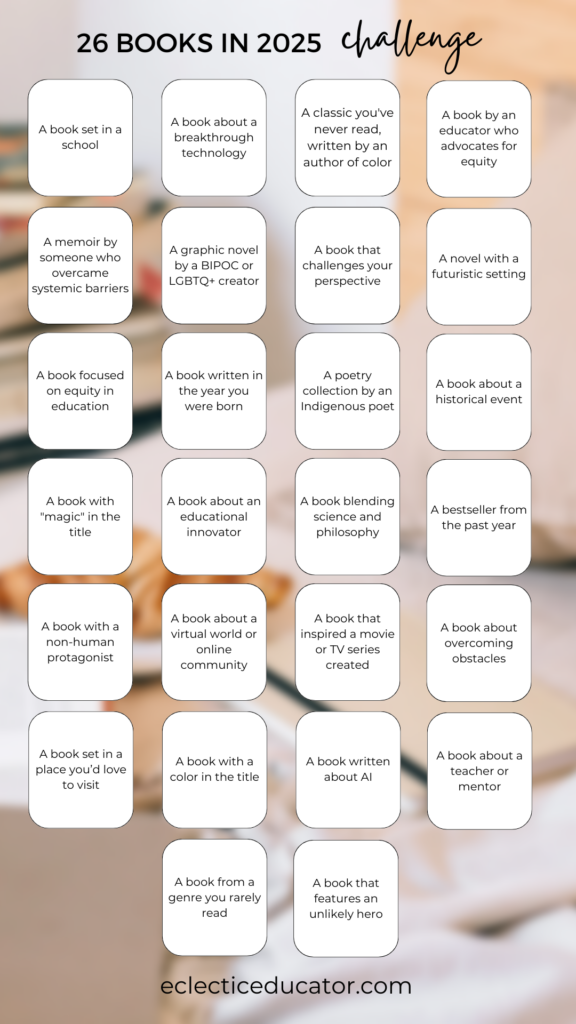
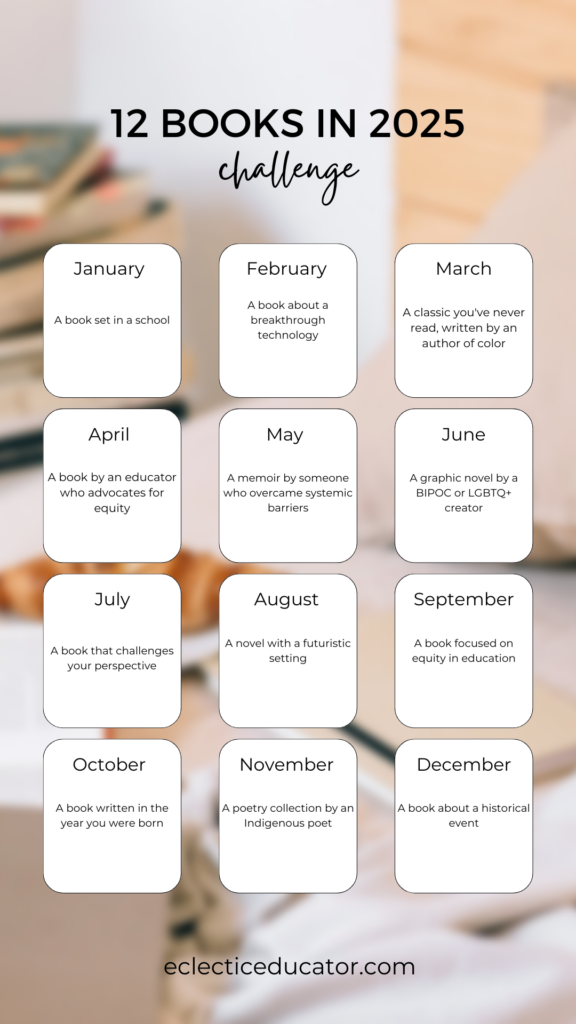
This year, I’ve curated a list of 26 prompts for the bold and adventurous reader (one every two weeks) and a streamlined 12-prompt version for those who prefer a slower pace (one per month). These aren’t just random topics pulled from a hat; they’re carefully crafted to encourage you to hear from voices you may not have encountered before, to explore unfamiliar perspectives, and to challenge your thinking about the world around you.


A Challenge with Purpose

The goal of this challenge isn’t just to fill up your bookshelf or meet a reading quota. It’s to stretch your imagination, broaden your understanding, and perhaps even ignite a slight transformation in how you view yourself, others, and our complex world.

Here’s a sneak peek at some of the prompts awaiting you:

  • A Book Set in a School: Because let’s face it—every great story starts in a classroom.
  • A Book Written by an Author from a Culture You’ve Never Explored: Expand your horizons and discover a voice that’s brand new to you.
  • A Novel with a Futuristic Setting: Perfect for letting your imagination run wild as you think about what’s to come.
  • A Book About a Historical Event That Interests You: Dive deep into a moment that shaped the world—and see it through the eyes of someone with a unique perspective.
  • A Memoir by Someone Who Overcame Systemic Barriers: Be inspired by resilience and strength in adversity.
  • A Book That Challenges Your Perspective: Choose something that might make you uncomfortable—and let it. Growth often starts there.

A Theme of Transformation

The overarching theme for 2025 is transformation. Whether it’s the transformation of a character, an idea, or even your understanding, each prompt is designed to change you by the time you turn the final page.


Free Printables for Your Reading Adventure

To make your reading journey even more engaging, I’m giving away a set of free printables exclusively for my newsletter subscribers. The set includes:

  • A Reading Challenge Tracker to keep you motivated as you check off each prompt.
  • Beautifully designed Journal Pages for capturing your reflections, favorite quotes, and memorable moments from each book.

These printables are perfect for organizing your reading challenge and adding a personal touch to your literary journey. Not a subscriber yet? Don’t miss out! Sign up for my newsletter today for instant access to these free resources and stay in the loop with tips, recommendations, and more.


26 Prompts (For the Adventurous Reader)

If you’re ready for the full challenge, here’s the list of 26 prompts to guide your reading:

2025 reading challenge prompts for 26 books
  1. A book set in a school
  2. A book about a breakthrough technology
  3. A classic you’ve never read, written by an author of color
  4. A book by an educator who advocates for equity
  5. A memoir by someone who overcame systemic barriers
  6. A graphic novel by a BIPOC or LGBTQ+ creator
  7. A book that challenges your perspective
  8. A novel with a futuristic setting
  9. A book focused on equity in education
  10. A book written in the year you were born
  11. A poetry collection by an Indigenous poet
  12. A book about a historical event
  13. A book with “magic” in the title
  14. A book about an educational innovator
  15. A book blending science and philosophy
  16. A bestseller from the past year
  17. A book with a non-human protagonist
  18. A book about a virtual world or online community
  19. A book that inspired a movie or TV series created
  20. A book about overcoming obstacles
  21. A book set in a place you’d love to visit
  22. A book with a color in the title
  23. A book about a teacher or mentor
  24. A book written about AI
  25. A book from a genre you rarely read
  26. A book that features an unlikely hero

12 Prompts (For the Leisurely Reader)

Prefer a simpler path? Here’s the 12-prompt version—one book a month:

2025 reading challenge prompts for 12 books
  1. January: A book set in a school
  2. February: A book about a breakthrough technology
  3. March: A classic you’ve never read, written by an author of color
  4. April: A book by an educator who advocates for equity
  5. May: A memoir by someone who overcame systemic barriers
  6. June: A graphic novel by a BIPOC or LGBTQ+ creator
  7. July: A book that challenges your perspective
  8. August: A novel with a futuristic setting
  9. September: A book focused on equity in education
  10. October: A book written in the year you were born
  11. November: A poetry collection by an Indigenous poet
  12. December: A book about a historical event

Ready to Begin?

The 2025 Reading Challenge invites you to explore, learn, and grow. Share your journey on social media with the hashtag #EclecticReading2025, and let’s make this the year we all embrace new ideas and stories.

Happy reading, Starfighters! 🚀


The Eclectic Educator is a free resource for everyone passionate about education and creativity. If you enjoy the content and want to support the newsletter, consider becoming a paid subscriber. Your support helps keep the insights and inspiration coming!

The Best Books of 2024: PBS NewsHour’s Top Picks

pile of books
Photo by Pixabay on Pexels.com

As we wrap up another year, PBS NewsHour has highlighted the most captivating books of 2024. With insights from renowned literary critics Maureen Corrigan of NPR’s Fresh Air and Gilbert Cruz, editor of The New York Times Book Review, this year-end list spans fiction, nonfiction, and even some unexpected gems. Here’s a closer look at their recommendations.

Fiction Favorites

All Fours by Miranda July

A middle-aged female artist embarks on a road trip from Los Angeles to New York but soon becomes obsessed with renovating a roadside motel and a younger man. July’s novel humorously explores middle age, motherhood, and desire, making it entertaining and deeply poignant.

You Dreamed of Empires by Alvaro Enrigue

Set in 1519 Tenochtitlan, this novel captures the encounter between Hernán Cortés and Aztec Emperor Moctezuma. Through a fascinating blend of tones, Enrigue delivers a vivid portrayal of cultural clashes, underscored by moments of humor and historical intrigue.

James by Percival Everett

Everett reimagines Huckleberry Finn from the perspective of Jim, the enslaved character. This National Book Award-winning novel is a heartfelt and humorous standalone story that reframes Twain’s classic in thought-provoking ways.

Colored Television by Danzy Senna

This sharp, satirical novel follows a mixed-race woman in Los Angeles as she navigates the challenges of writing an epic novel about identity. Failing to gain traction, she shifts to television, delivering biting commentary on race, class, and the writing profession.

Nonfiction Standouts

The Wide Wide Sea by Hampton Sides

This historical nonfiction book, an engaging account of Captain James Cook’s final voyage in 1776, balances thrilling seafaring adventure with a modern reflection on imperialism’s impacts.

Everyone Who Is Gone Is Here by Jonathan Blitzer

Blitzer chronicles 50 years of immigration policy at the U.S.-Mexico border, focusing on Honduras, Guatemala, and El Salvador. His meticulous research provides a compelling look at this enduring issue’s political and human dimensions.

A Wilder Shore by Camille Peri

This biography of Fanny Stevenson, wife of Robert Louis Stevenson, highlights her adventurous life, artistic pursuits, and resilience in the face of adversity. It’s an inspiring story about living boldly.

The Letters of Emily Dickinson

This collection of 300 previously unpublished letters offers a rare glimpse into the mind of one of America’s greatest poets. It’s a treasure for Dickinson enthusiasts and anyone seeking literary insight.

Bonus Picks

Karla’s Choice by Nick Harkaway

Set between The Spy Who Came in from the Cold and Tinker Tailor Soldier Spy, Harkaway continues his father John le Carré’s espionage legacy with a thrilling tale of George Smiley and his nemesis, Karla.

The Dog Who Followed the Moon by James Norbury

This beautifully illustrated and inspirational story about a lost dog navigating life’s uncertainties resonates with anyone seeking direction. The stunning artwork and gentle narrative make it a comforting read.

Conclusion

From historical sagas to contemporary reflections, PBS NewsHour’s selections for 2024 offer something for every reader. Whether you’re seeking inspiration, adventure, or a fresh perspective, these books promise to deliver.

Which of these will you add to your reading list? Please share your thoughts in the comments below, and let us know your favorite reads of 2024!


The Eclectic Educator is a free resource for everyone passionate about education and creativity. If you enjoy the content and want to support the newsletter, consider becoming a paid subscriber. Your support helps keep the insights and inspiration coming!